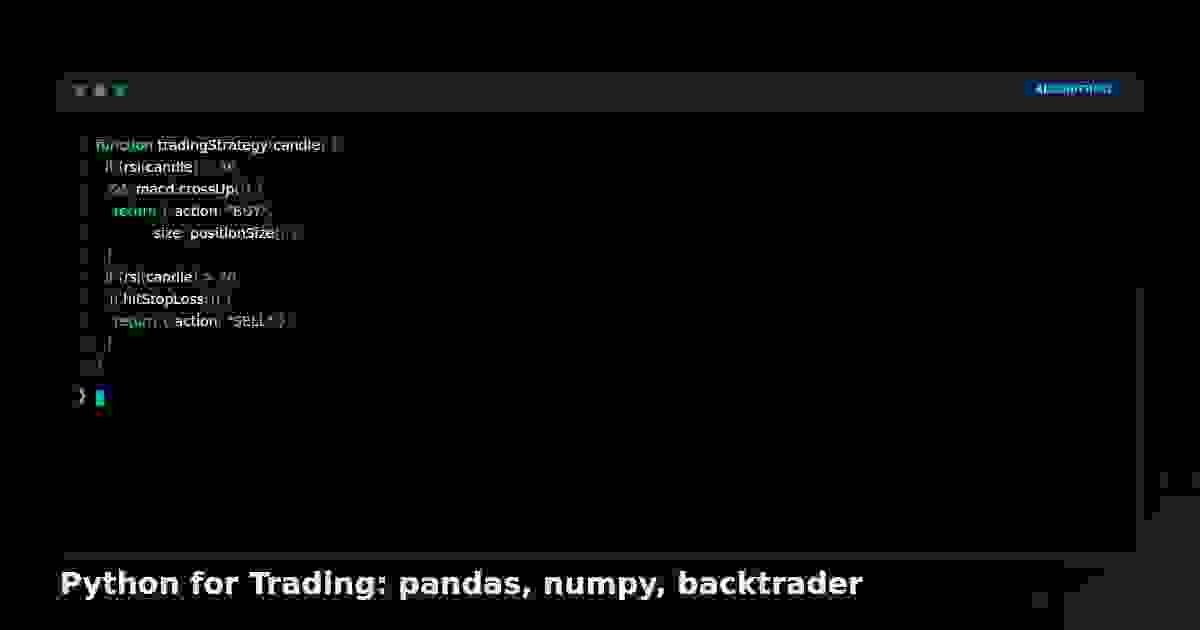
Python for Trading: pandas, numpy, backtrader
Python is the workhorse of quant research. Learn the three libraries every trader needs — pandas, numpy, and backtrader — and what each one does.
Python for Trading: pandas, numpy, backtrader
Three libraries carry 90% of retail quant work. Master them and you can build, test, and trade almost anything.
Python's dominance in trading comes from its library ecosystem. Three packages in particular form the backbone of nearly every retail quant workflow: numpy for the math, pandas for the data, and backtrader (or a peer) for the strategy.
numpy: the numeric engine
numpy gives you fast array operations without Python loops. Every other quantitative library is built on it.
Core ideas:
- Vectorization: operate on whole arrays at once, not element-by-element
- Broadcasting: combine arrays of different shapes cleanly
- Linear algebra: matrix operations, eigenvalues, regression solvers
A 100k-bar return series computed in numpy is ~100× faster than the equivalent Python loop. Any serious backtest depends on this.
import numpy as np
returns = np.diff(np.log(prices))
sharpe = np.mean(returns) / np.std(returns) * np.sqrt(252)
pandas: the data wrangler
pandas adds labeled, time-indexed data — exactly what OHLCV bars are. It's the workhorse for cleaning, aligning, and transforming market data.
Essential patterns:
- DataFrame: a 2D table indexed by timestamp
- Resampling: convert 1-minute bars to 5-minute, daily to weekly
- Rolling windows: moving averages, rolling σ
- Groupby: per-symbol or per-day aggregations
- Reindexing: align two assets on a common timeline
import pandas as pd
df['sma'] = df['close'].rolling(50).mean()
df['vol'] = df['close'].pct_change().rolling(20).std()
90% of quant research time is spent in pandas — getting data clean enough that the math is meaningful.
backtrader: the strategy tester
backtrader is a Python framework for backtesting event-driven strategies. It handles order simulation, broker modeling, commission, slippage, and multi-asset portfolios.
Structure of a typical strategy:
class SmaCross(bt.Strategy):
    params = (('fast', 20), ('slow', 50))
    def __init__(self):
        self.fast = bt.ind.SMA(self.data.close, self.p.fast)
        self.slow = bt.ind.SMA(self.data.close, self.p.slow)
        self.cross = bt.ind.CrossOver(self.fast, self.slow)
    def next(self):
        if self.cross > 0:
            self.buy()
        elif self.cross < 0:
            self.close()
backtrader forces you to think in event-driven terms — what happens bar-by-bar — which is closer to live trading than vectorized backtests.
Alternatives to backtrader
- vectorbt: vectorized, extremely fast, great for parameter sweeps
- Backtesting.py: minimal and clean for simple strategies
- Zipline / Zipline-Reloaded: Quantopian's old engine, still used for factor research
- QuantConnect Lean: cloud-based, multi-asset, production-grade
A realistic workflow
- Pull data into a pandas DataFrame, clean it (timezone, gaps, splits)
- Engineer features with pandas rolling/groupby
- Test signal logic with numpy
- Build the strategy in backtrader with realistic commissions
- Run walk-forward and out-of-sample tests
- Connect to a broker API (ccxt for crypto, broker SDKs for equities)
Summary
numpy does the math fast, pandas handles the data, and backtrader simulates the trading. Together they cover the full quant research loop. Master these three and you can prototype, test, and refine almost any strategy a retail trader would ever want to build.
Live Chart
Open full chart →Related market data, powered by TradingView.
My Notes
Log in to save notes on this article and share them with the community.
Read next
Quant Research Workflow: Jupyter Notebooks and Feature Engineering
A repeatable quant research workflow using Jupyter notebooks covers feature engineering, validation, and notebook hygiene that produces deployable signals.
Read more →Smart Recommendations