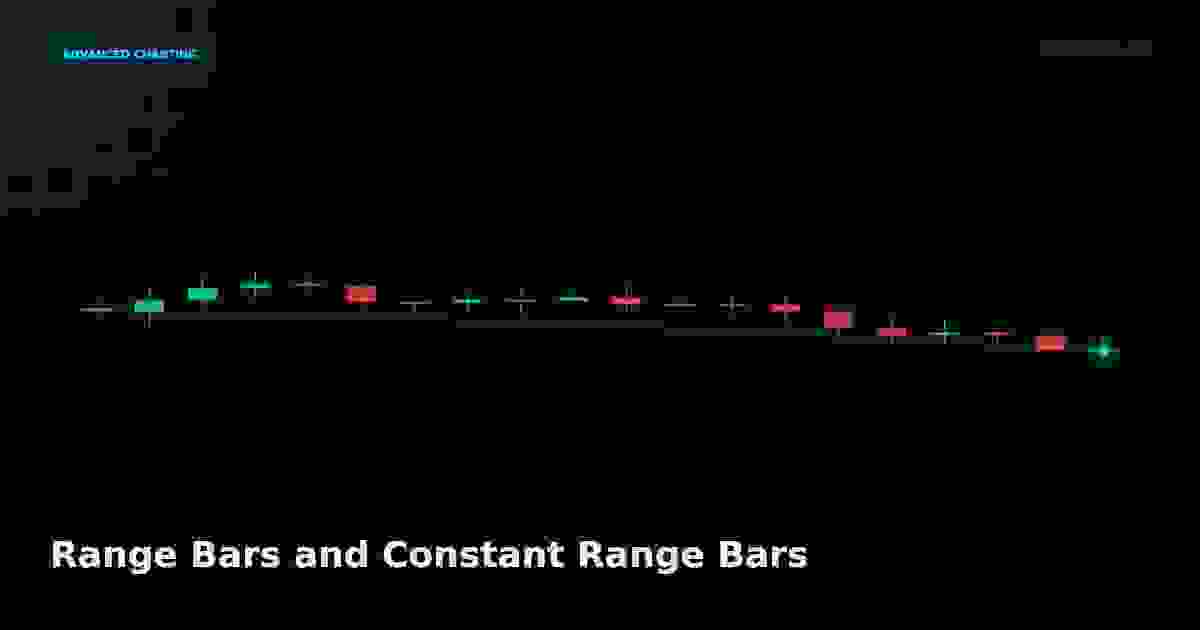
Range Bars and Constant Range Bars
Range bars print a new candle only when price travels a fixed distance, removing time from the chart and giving scalpers clean volatility-based setups.
Range Bars and Constant Range Bars
A range bar chart asks one question: did price move X ticks? If yes, new bar. If no, the current bar keeps developing. Time is irrelevant — only distance matters.
Range bars (also called constant range bars) were popularized by Brazilian trader Vicente Nicolellis. Every bar represents the same amount of price movement. A 5-point range bar on the S&P 500 closes the moment price moves 5 points from open to close.
How a range bar is built
- The bar opens at the close of the previous bar.
- The bar closes when price travels exactly range size from open to high or open to low.
- The next bar opens where the previous closed.
- No bar exists while price is idle.
In slow sessions an hour might print three bars; in active sessions, thirty. The chart breathes with volatility.
Choosing the range size
- Too small: bars print so fast the chart is noise; spreads and commissions dominate.
- Too large: bars print so slowly you wait hours for a setup.
- Rule of thumb: set the range to roughly 0.5 × ATR on the 5-minute chart.
Why traders use range bars
- Volatility normalization: every bar carries the same information density, so indicators behave more consistently.
- Cleaner channels: support and resistance trendlines fit range bars neatly.
- Faster signals in active markets: bars only print when there is movement.
A range bar scalping strategy
- Use a range that produces 5–10 bars per hour in your market's typical session.
- Add a 20-period EMA on the range chart.
- Take only longs when price is above the EMA and a green bar closes above the prior bar's high.
- Stop loss: 1 range below the entry bar's low.
- Target: 1.5–2 × the range.
Avoid trading during news: range bars print erratically during fast moves, and spreads widen.
Range bars vs. Renko
| Feature | Range Bars | Renko |
|---|---|---|
| Bar trigger | Fixed distance open-to-close | Fixed distance close-to-close |
| Wicks | Shows high/low | No wicks |
| Best for | Scalping, active markets | Trend following |
Many traders combine the two: Renko on the daily for trend, range bars on the 5-minute for entries.
Common pitfalls
- Forgetting commissions: each bar's slippage can wipe out small scalps. Account for costs in every backtest.
- Over-trading: more bars tempt more trades. Limit yourself to 3–5 setups per session.
- Ignoring context: a green range bar in a downtrend is not a buy. Always confirm with the higher timeframe.
Use range bars only on instruments with real volume and tight spreads: index futures, major FX pairs, large-cap stocks. In illiquid markets they print slowly and unreliably.
Live Chart
Open full chart →Related market data, powered by TradingView.
My Notes
Log in to save notes on this article and share them with the community.
Read next
Renko vs Kagi vs Line Break: Choosing the Right Alternative Chart
Renko, Kagi, and Three-Line-Break each filter noise differently, and matching the chart type to market regime, holding period, and instrument volatility produces measurably better trend reads than defaulting to one.
Read more →Smart Recommendations