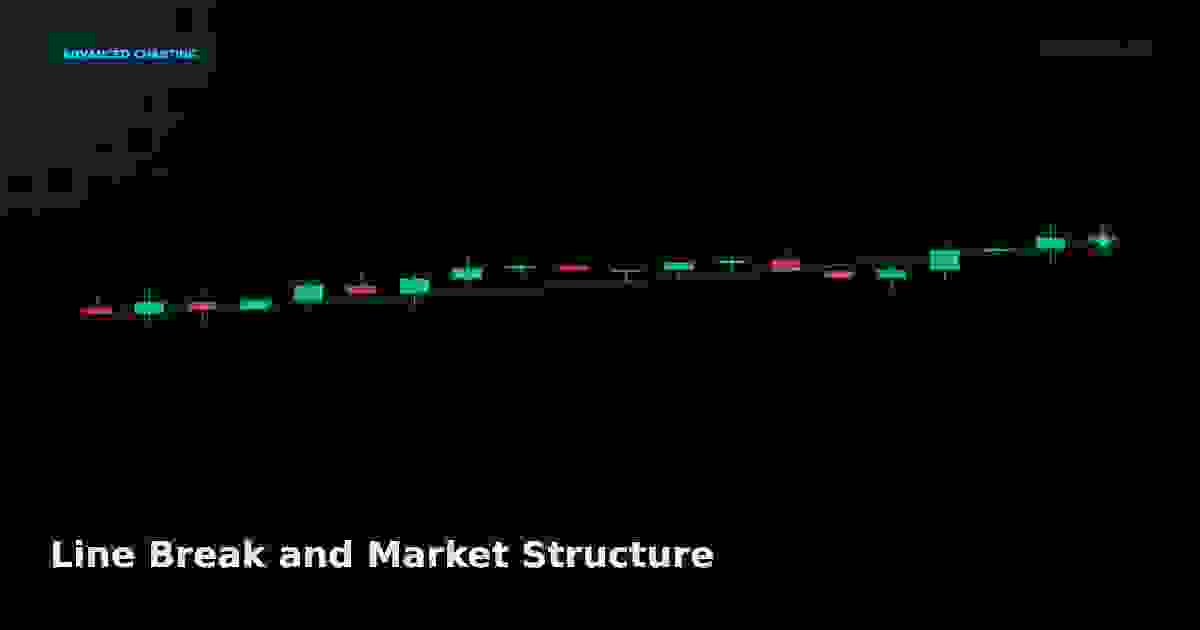
Line Break and Market Structure
Line break methods expose market structure — the sequence of higher highs, lower lows, and break of structure points that define trend direction.
Line Break and Market Structure
Every trend is a sequence of structural points: higher highs and higher lows in an uptrend, lower highs and lower lows in a downtrend. Line break charts make those points unmissable by printing only the structure that matters.
Line break charts — including Three Line Break, Two Line Break, and Renko variations — share a common purpose: strip the chart down to its structural skeleton. The result is a clean view of market structure, free from intrabar noise that masks the true trend.
What market structure means
Markets move in waves. An uptrend is built from:
- Higher High (HH) — each new high exceeds the previous high.
- Higher Low (HL) — each pullback bottoms above the previous pullback.
A downtrend mirrors this: Lower Highs (LH) and Lower Lows (LL).
A Break of Structure (BOS) happens when price closes beyond the most recent swing high (in an uptrend) or swing low (in a downtrend). A Change of Character (CHOCH) happens when the trend itself reverses — the first LH after a string of HHs, or the first HL after a string of LLs.
How line break charts expose structure
Line break charts print only structural moves:
- A sequence of same-direction lines = HH/HL or LH/LL intact.
- A reversal line that breaks three prior lines = potential CHOCH.
- A small line that fails to exceed the prior line = hesitation before a BOS.
Because the chart ignores wicks and gaps, you see only the structure that actually changed. False breakouts (wicks that reverse) often don't print at all.
A structural line break strategy
- Identify the trend: count the recent lines. More green lines above the prior range = uptrend.
- Wait for a pullback (in an uptrend, a red line that doesn't break the three-line threshold).
- Enter long when a new green line prints, confirming HH/HL structure is intact.
- Stop loss below the low of the pullback line.
- Exit when a reversal red line breaks the prior three green lines (CHOCH signal).
This forces you to trade with the trend, on pullbacks, with a defined invalidation point.
The line break advantage
Candlestick charts bury structure under wicks and gaps. A candle that spikes through a prior high but closes back inside has not broken structure — but on a candlestick chart, it looks like it did. Line break charts ignore the spike entirely unless price closed structurally beyond it.
That distinction matters because fake breakouts are one of the most expensive traps for new traders. Line break methods filter them automatically.
Pitfalls
- Late signals: structure requires confirmation, so entries lag the turn.
- Range markets: when highs and lows cluster, line break prints many small lines without clear trend.
Verify a BOS with volume or footprint charts before committing — pure structure misleads on low volume. Line break charts aren't a complete system — they're a lens.
Live Chart
Open full chart →Related market data, powered by TradingView.
My Notes
Log in to save notes on this article and share them with the community.
Read next
Renko vs Kagi vs Line Break: Choosing the Right Alternative Chart
Renko, Kagi, and Three-Line-Break each filter noise differently, and matching the chart type to market regime, holding period, and instrument volatility produces measurably better trend reads than defaulting to one.
Read more →Smart Recommendations