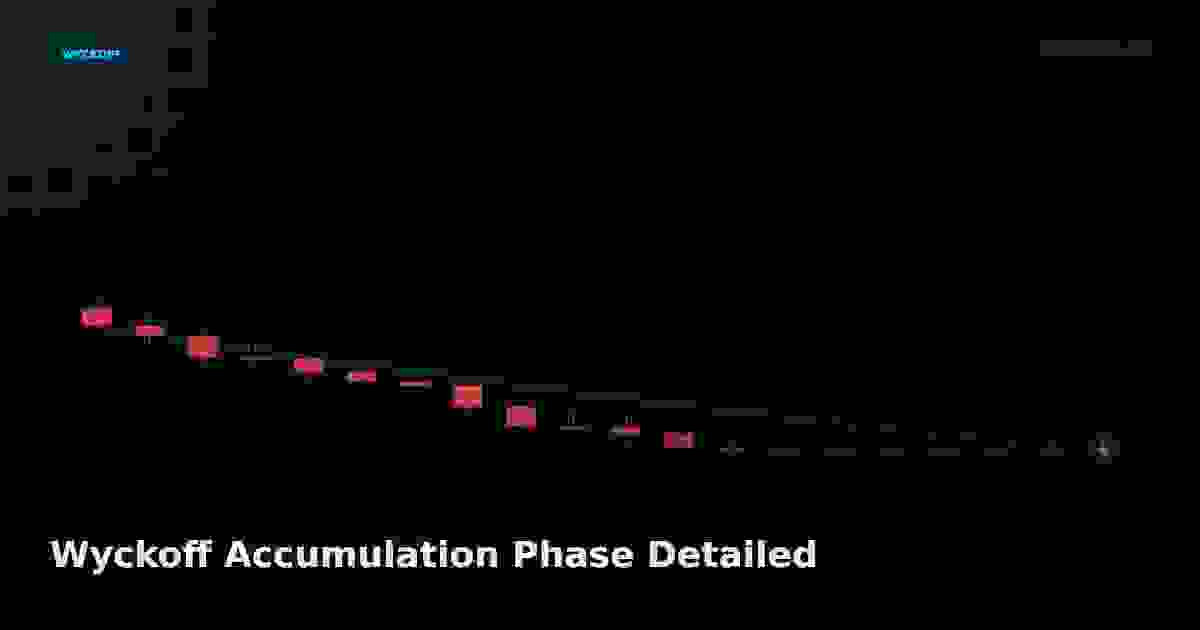
Wyckoff Accumulation Phase Detailed
The accumulation schematic maps how smart money quietly builds positions — learn the five phases, key events, and the spring that confirms the start of markup.
Wyckoff Accumulation Phase Detailed
Accumulation is the phase where large operators quietly buy shares from a weak, fearful public, building positions without driving the price higher. The Wyckoff accumulation schematic maps this process in detail — phase by phase, event by event — giving traders a roadmap for identifying the start of new uptrends.
The context: after a markdown
Accumulation begins after a prolonged decline. The public is fearful, holding losses, and eager to sell. Smart money sees value and begins absorbing supply. This transition from markdown to accumulation is marked by a Preliminary Support (PS) and a Selling Climax (SC).
Phase A: stopping the downtrend
- Preliminary Support (PS): the first sign that selling pressure is easing. Volume increases, downside narrows. Some buyers are stepping in.
- Selling Climax (SC): the capitulation bar. Wide spread down, ultra-high volume, close off the low. Panic sellers meet aggressive buyers.
- Automatic Rally (AR): price bounces sharply as residual demand is met by exhausted supply. The high of this rally defines the top of the accumulation range.
- Secondary Test (ST): price revisits the SC low on diminished volume, confirming that selling pressure is exhausted.
Phase A's job is to stop the downtrend and establish a trading range.
Phase B: building the cause
Phase B is the longest phase. Price oscillates within the range defined by the SC low and AR high. Large operators accumulate patiently, supporting price on dips and capping it on rallies. Volume is generally lower and more variable than during Phase A. Multiple Secondary Tests may occur.
Phase B is boring by design — the public loses interest, exactly what the composite operator wants. The cause is being built here; the larger the Phase B, the larger the eventual markup.
Phase C: the spring
Phase C is the most important — and most easily missed. Here, the composite operator engineers a final shakeout:
- Spring: price briefly breaks below the support of the trading range (the SC low), often on diminished or moderate volume, then snaps back. This triggers stop-loss orders below support and induces final capitulation from weak holders — exactly the shares the CO wants.
- Test of the Spring: a subsequent minor pullback that holds above the spring low, on reduced volume. This confirms supply is exhausted.
Springs come in three forms:
- Spring #1: breaks below support, then immediately recovers — strongest
- Spring #2: holds just above support — moderate
- Spring #3: holds well above support — weakest, often a higher-risk entry
A spring that occurs on high volume but fails to follow through on the downside is a textbook effort/result divergence — supply is exhausted.
Phase D: demand enters
Once the spring confirms that supply is gone, demand begins to dominate:
- Sign of Strength (SOS): a wide up bar on high volume that breaks above prior resistance within the range
- Backup to the Edge of the Creek (BUEC): a pullback that holds above the prior resistance (now support) on reduced volume — the classic Wyckoff entry point
- LPS (Last Point of Support): another name for the BUEC, the final low-risk entry before markup
Phase D shows higher lows and higher highs within the range — demand is now in control.
Phase E: markup begins
Price breaks out above the AR high (the top of the range) on strong volume. The accumulation is complete. The markup phase — the uptrend — begins in earnest.
How to trade accumulation
- Identify the range after a markdown (Phase A complete)
- Wait for the spring (Phase C) — the highest-probability entry
- Confirm with the SOS — never buy the spring without seeing follow-through
- Enter on the BUEC — the pullback after the SOS, with a stop below the spring low
- Target: use point-and-figure counting to project the size of the markup from the accumulation range
Common mistakes
- Buying Phase B lows: the range may last months; early entries tie up capital
- Shorting the spring: mistaking the spring for a breakdown and shorting into the shakeout
- Missing the SOS: entering on the spring but failing to wait for confirmation, getting stopped out on the test
- Ignoring volume: a spring on rising volume is suspect — true springs show diminished or absorbing volume
Summary
The accumulation schematic gives traders a complete map: Phase A stops the decline, Phase B builds the cause, Phase C springs the trap on weak holders, Phase D confirms demand, Phase E launches the markup. Identify each event in sequence, wait for confirmation, and enter at the BUEC with a structural stop below the spring.
Live Chart
Open full chart →Related market data, powered by TradingView.
My Notes
Log in to save notes on this article and share them with the community.
Read next
Wyckoff vs SMC vs Supply and Demand: A Method Comparison for Traders
A head-to-head comparison of Wyckoff, Smart Money Concepts, and supply/demand methods, covering strengths, weaknesses, and when each approach fits best.
Read more →Smart Recommendations