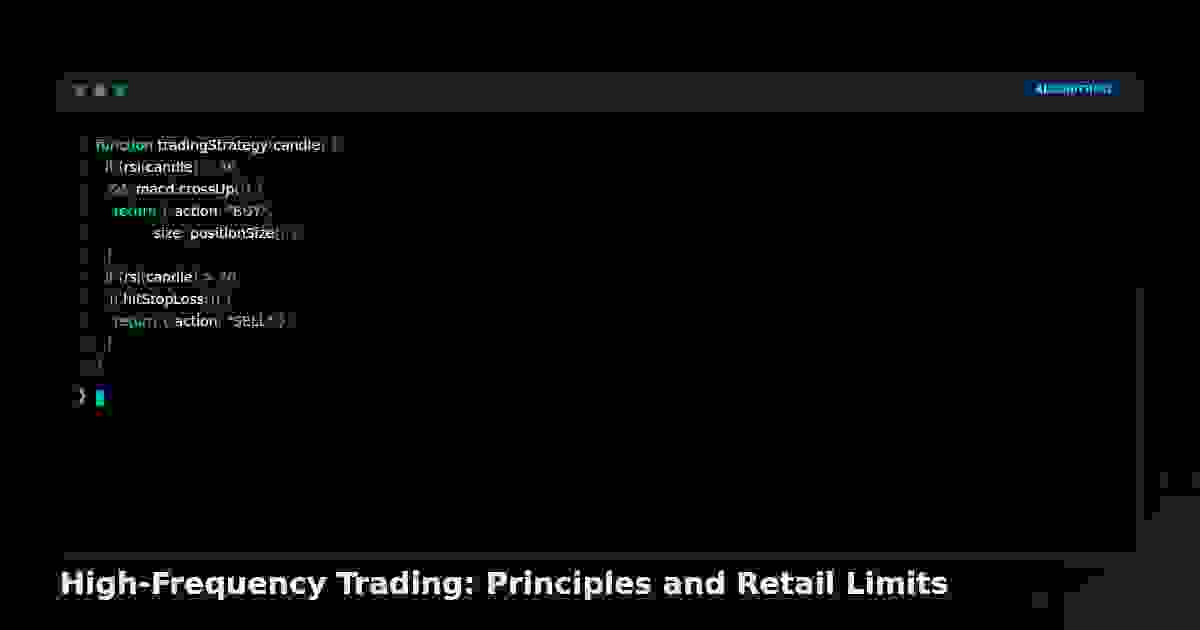
High-Frequency Trading: Principles and Retail Limits
HFT is a different game played with different tools. Learn what high-frequency trading actually is, why it works, and where retail traders hit a hard wall.
High-Frequency Trading: Principles and Retail Limits
HFT is not "fast day trading." It's a hardware and infrastructure business where microseconds decide who wins. Retail cannot compete here — and shouldn't try.
High-frequency trading (HFT) is one of the most misunderstood corners of the market. Knowing what it actually is — and why retail traders cannot do it — clarifies which strategies you can run.
What HFT actually is
HFT strategies hold positions for seconds or milliseconds and rely on three pillars:
- Speed: colocated servers in the exchange data center, microwave links between cities, FPGA-accelerated network stacks
- Order book microstructure: making markets, capturing the spread, reacting to order flow imbalance
- Volume, not edge per trade: tiny profit per trade, millions of trades per day
Common HFT strategies:
- Market making: quote both sides, capture the spread, manage inventory risk
- Statistical arbitrage at the tick level: fleeting price dislocations across venues
- Latency arbitrage: react to a price change on one exchange before another exchange updates
- Event arbitrage: machine-readable news in milliseconds
Why it works
HFT profit comes from being first. The first order to arrive captures the spread; later orders get nothing. The economics reward tiny per-trade profits compounded across enormous volume, with very low variance per day.
The key metric is Sharpe ratio: HFT desks routinely run Sharpe of 5–20 because their returns are so steady. The catch: that edge has capacity — it stops working once more capital chases the same micro-dislocations.
Why retail cannot compete
- Colocation costs: $5,000–$50,000/month per server in an exchange data center
- Market data fees: direct exchange feeds cost tens of thousands annually
- Network latency: a home broadband connection is 100× too slow
- Fee structures: HFT firms negotiate maker-taker rebates unavailable to retail
- Capital: market making requires millions in inventory to be viable
- Software: FPGA and C++ on bare metal, not Python
Even if a retail trader wrote perfect HFT code, the infrastructure deficit alone makes it uncompetitive.
Where the retail wall is
The line between "fast automated trading" and "HFT" is roughly:
- Holding time under 1 second → HFT territory; retail cannot compete
- Holding time 1 second to 1 day → intraday algo trading; retail can compete
- Holding time days+ → swing/position trading; retail's natural home
A strategy that needs to react in 10 milliseconds is closed to you. A strategy that holds for 10 minutes is wide open.
What retail can learn from HFT
Even if you can't run HFT, its principles are useful:
- Market microstructure: understanding the order book, spreads, and depth makes you a better trader at any timeframe
- Cost discipline: HFT obsesses over basis points of cost; retail should too — slippage matters
- Latency awareness: knowing why your fills lag helps you route better
- Inventory management: HFT's risk controls on inventory are transferable to any book
Summary
HFT is an infrastructure arms race where microseconds and millions of dollars decide the winner. Retail traders cannot and should not try to compete there. But understanding what HFT does — market making, latency capture, microstructure exploitation — sharpens your sense of who is on the other side of your trades, and where your own edges can realistically live.
Live Chart
Open full chart →Related market data, powered by TradingView.
My Notes
Log in to save notes on this article and share them with the community.
Read next
Quant Research Workflow: Jupyter Notebooks and Feature Engineering
A repeatable quant research workflow using Jupyter notebooks covers feature engineering, validation, and notebook hygiene that produces deployable signals.
Read more →Smart Recommendations