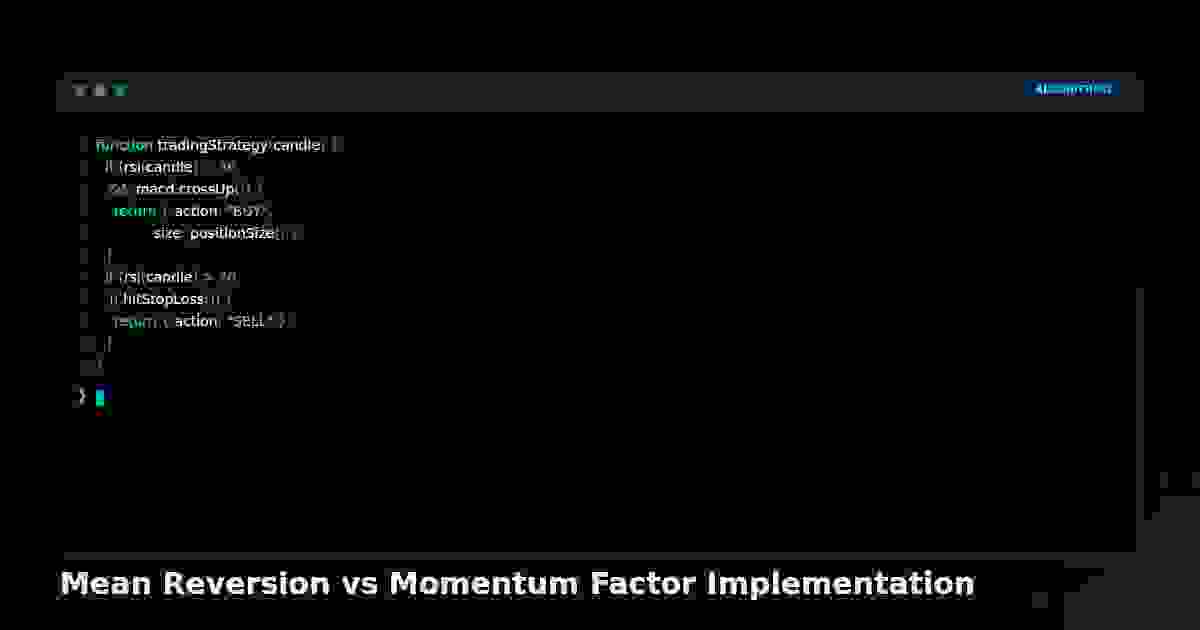
Mean Reversion vs Momentum Factor Implementation
Mean reversion and momentum are the two most studied factors — and they pull in opposite directions. Learn how to build, distinguish, and combine them.
Mean Reversion vs Momentum Factor Implementation
Momentum says what goes up keeps going. Mean reversion says what goes up comes back. Both are right — at different timeframes.
The two most studied factors in quantitative finance contradict each other on the surface. Resolving the contradiction is one of the most useful skills a trader can develop.
The two forces
Momentum — assets that outperformed over the past 6–12 months tend to keep outperforming. Driven by slow information diffusion, herding, and underreaction.
Mean reversion — assets that moved far from their fair value tend to snap back. Driven by overreaction, liquidity shocks, and the simple fact that prices can't diverge from fundamentals forever.
The reconciliation: momentum works on long horizons (months); mean reversion works on short horizons (minutes to weeks). The same asset can show both, depending on the window.
Implementing momentum
Classic cross-sectional momentum:
Momentum_t = (Price_t ÷ Price_{t−252}) − 1
Then rank assets cross-sectionally each period, long the top tercile, short the bottom. Skip the most recent month (short-term reversals contaminate long-term momentum).
Position"/glossary/position-sizing" class="glossary-link" data-auto-linked="true">Position sizing often scales with the signal strength:
Weight_i = (Signal_i − mean(Signal)) ÷ std(Signal)
Implementing mean reversion
Classic short-horizon reversion uses z-scores of deviation from a moving average:
Z = (Price − SMA_n) ÷ σ_n
- Buy when Z < −2 (price stretched below the mean)
- Sell/short when Z > +2 (price stretched above)
- Exit when Z returns toward 0
Pairs trading extends this to the spread between two cointegrated assets.
Why they can coexist
A stock can show 12-month momentum and 5-day mean reversion simultaneously. The market trends slowly upward over months (momentum) but oscillates around that trend on a daily basis (reversion). The two effects operate on different timescales and so don't cancel — they layer.
Combining the two
A practical blended strategy:
- Use long-horizon momentum (6–12 months) for directional bias
- Use short-horizon reversion (1–5 days) for entry timing
- Only take reversion trades in the direction of the momentum signal
This avoids the classic mistake of fading a strong trend with a reversion entry — the most common way reversion strategies blow up.
Risk differences
- Momentum crashes: sharp reversals during regime changes (e.g., 2009). Negative skew
- Mean reversion crashes: rare but severe — the "reversion" never comes and the position keeps bleeding. Also negative skew
Both strategies have fat left tails. Size conservatively and use stops or volatility targeting.
Practical steps
- Compute both signals on your universe
- Confirm momentum dominates at long horizons, reversion at short — for your assets
- Use momentum for direction, reversion for timing
- Risk-adjust each by volatility, not capital
- Monitor correlation between the two: when it spikes negative, you're entering a regime change
Summary
Momentum and mean reversion are not opposites — they're complementary regimes operating on different timescales. Use momentum to define the trend direction and mean reversion to time entries within it. Get the timescale right, and the apparent contradiction becomes one of the most robust edges in systematic trading.
Live Chart
Open full chart →Related market data, powered by TradingView.
My Notes
Log in to save notes on this article and share them with the community.
Read next
Quant Research Workflow: Jupyter Notebooks and Feature Engineering
A repeatable quant research workflow using Jupyter notebooks covers feature engineering, validation, and notebook hygiene that produces deployable signals.
Read more →Smart Recommendations