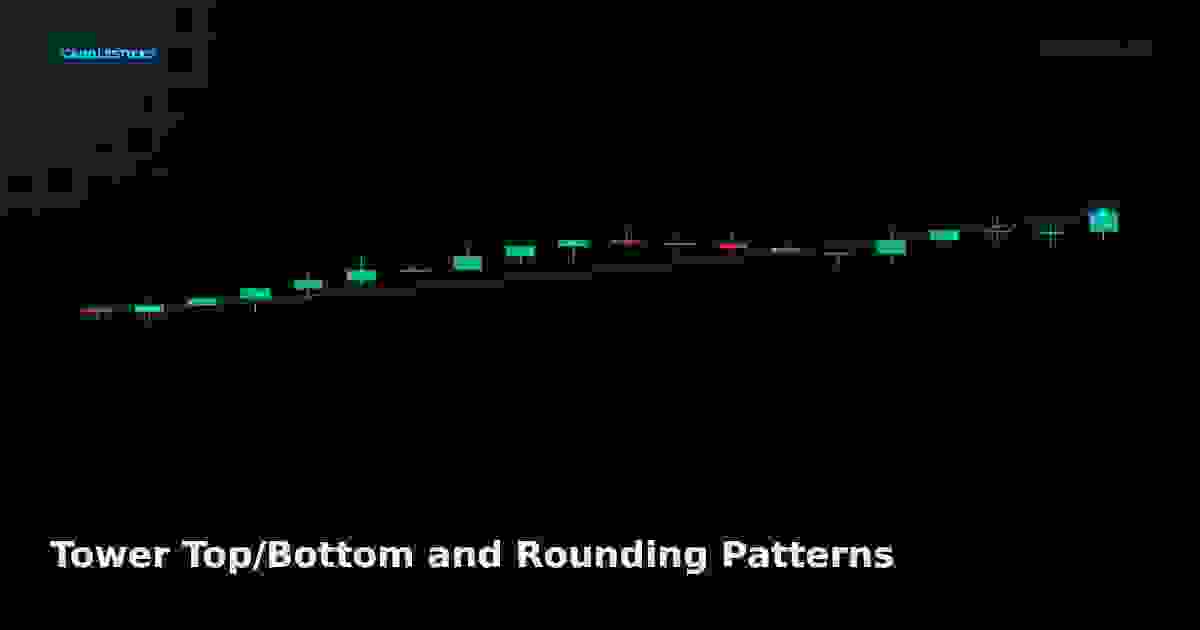
Tower Top/Bottom and Rounding Patterns
Tower formations and rounding tops and bottoms capture slow regime shifts that single-candle patterns cannot, marking major structural reversals over many sessions.
Tower Top/Bottom and Rounding Patterns
Not all reversal signals form in a single candle. Tower tops, tower bottoms, and rounding formations unfold over many sessions, capturing the slow rotation of control from buyers to sellers (or vice versa). These patterns are less flashy than a hammer or engulfing bar, but they often mark more significant reversals because the regime shift they capture is structural rather than emotional.
Tower Top
A tower top forms after an extended rally:
- A sustained advance produces a horizontal plateau — multiple candles closing near the same high, with small bodies and overlapping ranges.
- A sharp decline breaks the plateau, often with a long bearish candle or a gap down.
- The resulting shape resembles an inverted "U" or the silhouette of a tower.
The plateau represents buyers exhausting their ability to push price higher. The subsequent decline confirms the handoff to sellers. Tower tops are most significant when the plateau coincides with a major resistance level and declining volume — a sign that the rally died on fading participation rather than a sudden shock.
Tower Bottom
The mirror: after an extended decline, price forms a horizontal low — a series of candles resting on support with small ranges. A sharp rally then breaks upward, completing the "U." Tower bottoms mark exhaustion of selling pressure and the start of accumulation by larger buyers.
Rounding Top and Bottom
Rounding patterns are slower and smoother versions of tower formations. Rather than a flat plateau followed by a sharp break, price arcs gradually from one direction to the other over many sessions or weeks.
- Rounding top — a slow transition from rising to falling prices, forming a dome shape.
- Rounding bottom (saucer) — a slow transition from falling to rising, forming a bowl.
Rounding patterns reflect gradual shifts in supply and demand rather than abrupt reversals. They are common in liquid markets where no single event forces a sharp turn.
Why These Patterns Matter
Single-candle reversals capture emotional spikes — a panic low, a euphoric high. Tower and rounding formations capture something different: the slow bleeding away of momentum that precedes a genuine regime change. Because they unfold slowly, they are easier to confirm and harder to fake.
A rounding bottom that builds over eight weeks on declining downside volume, then accelerates upward on rising volume, is one of the most reliable bullish reversal structures in technical analysis. The equivalent single-candle signal would be far easier to dismiss as noise.
Practical Identification
These patterns are best identified by:
- Smoothed charts — line charts or Heikin Ashi often make rounding shapes clearer than raw candlesticks.
- Volume patterns — rounding bottoms typically show volume declining through the bowl's low and rising through the right side; rounding tops show the inverse.
- Multi-week inspection — daily candle-by-candle reading can obscure the macro shape. Zoom out.
Trading the Formation
Tower and rounding patterns are difficult to trade aggressively because they confirm only after the break. The disciplined approach:
- Entry: On the break of the plateau or on the acceleration leg of the rounding pattern, after volume confirms.
- Stop: Below the pattern's low (for longs) or above its high (for shorts).
- Target: A measured move based on the pattern's depth, projected from the breakout point.
These patterns reward patience. The trader who waits for the structure to complete enters with defined risk into a confirmed regime shift — a far higher-probability setup than chasing a single dramatic candle.
Live Chart
Open full chart →Related market data, powered by TradingView.
My Notes
Log in to save notes on this article and share them with the community.
Read next
VaR and CVaR Calculation Methods and Their Limitations
VaR and CVaR calculation methods — historical, parametric, and Monte Carlo — with Python implementation and the specific limitations each method hides.
Read more →Smart Recommendations