Kagi Charts: Reversal-Based Trading
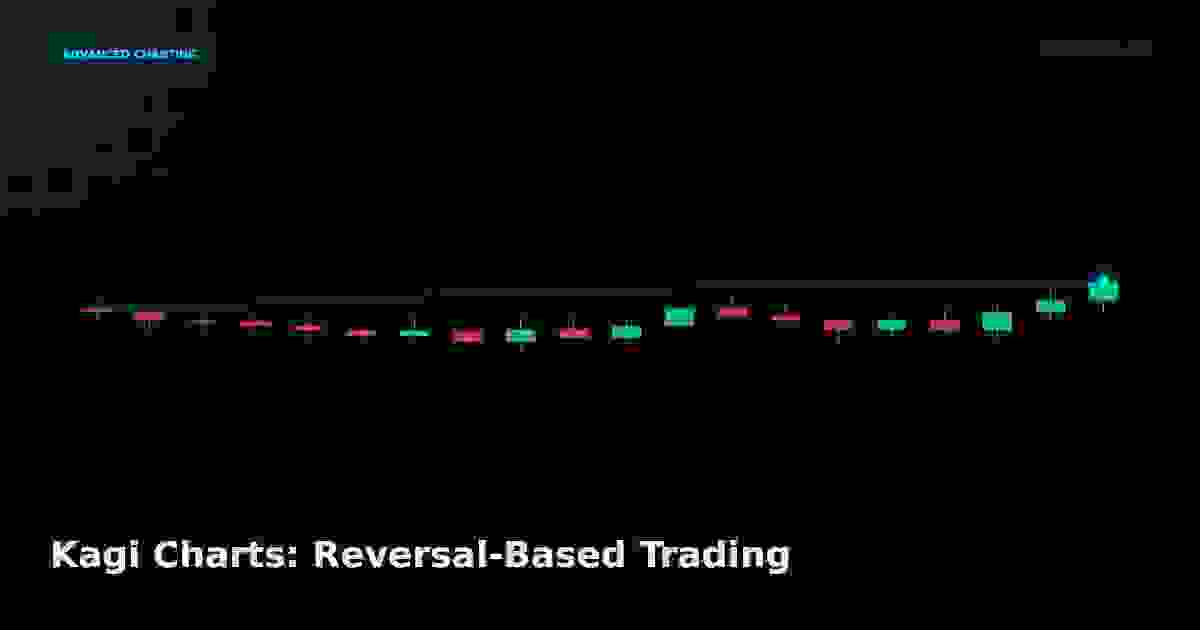
Kagi charts track price with thick and thin lines that flip only on a meaningful reversal, isolating trend shifts from intrabar noise.
Kagi Charts: Reversal-Based Trading
A Kagi line doesn't care when price moves — only that it moved enough to matter. When it does, the line changes thickness, signalling a shift in power between buyers and sellers.
Kagi is a Japanese charting method dating to the 1870s, originally used for rice prices. Where Renko prints bricks and P&F prints Xs and Os, Kagi draws a single line that thickens or thins based on the trend.
How Kagi lines work
A Kagi line moves vertically with price. When price reverses by a set reversal amount (often a percentage, like 4%), the line shifts one column right and reverses. If the new line breaks the prior high or low, the thickness changes:
- Yang line (thick): price broke above a prior high — bullish.
- Yin line (thin): price broke below a prior low — bearish.
Each yang/yin transition is a market-structure event, not a single candlestick.
Reading the line
- Yang-to-yin (thick to thin): trend turned bearish — exit longs, consider shorts.
- Yin-to-yang (thin to thick): trend turned bullish — exit shorts, consider longs.
- Shoulder — a mark where the line failed to make a new high before reversing. Resistance.
- Waist — a mark where the line failed to make a new low. Support.
A Kagi reversal strategy
- Set the reversal amount to roughly 1 × ATR of your trading timeframe.
- Wait for a yin-to-yang transition — the line thickens as it breaks a prior high.
- Enter long on the close of the candle that completed the break.
- Stop loss below the most recent waist.
- Exit on the next yang-to-yin transition.
This skips the noise of every candlestick reversal and acts only on confirmed structural flips.
Advantages
- No time distortion: slow days show short lines; fast days show long lines.
- Clear transitions: the only signals are when the line changes weight.
- Self-adjusting: with ATR-based reversal, Kagi adapts to volatility.
Disadvantages
- Late signals: confirmation costs price.
- Ranging markets: sideways action produces many small yang/yin flips — whipsaw risk.
- Limited tooling: not all platforms support Kagi.
When Kagi works best
Kagi shines in trending, volatile instruments — index futures, commodities, large-cap stocks with extended runs. It is weakest in low-volatility ranges where reversals happen but never break structure.
For traders who struggle to hold winners, Kagi offers a visual rule: stay in the trade while the line is thick, exit when it thins. That simple discipline often beats complex systems.
Live Chart
Open full chart →Related market data, powered by TradingView.
My Notes
Log in to save notes on this article and share them with the community.
Read next
Renko vs Kagi vs Line Break: Choosing the Right Alternative Chart
Renko, Kagi, and Three-Line-Break each filter noise differently, and matching the chart type to market regime, holding period, and instrument volatility produces measurably better trend reads than defaulting to one.
Read more →Smart Recommendations