Renko Charts: Filtering Market Noise
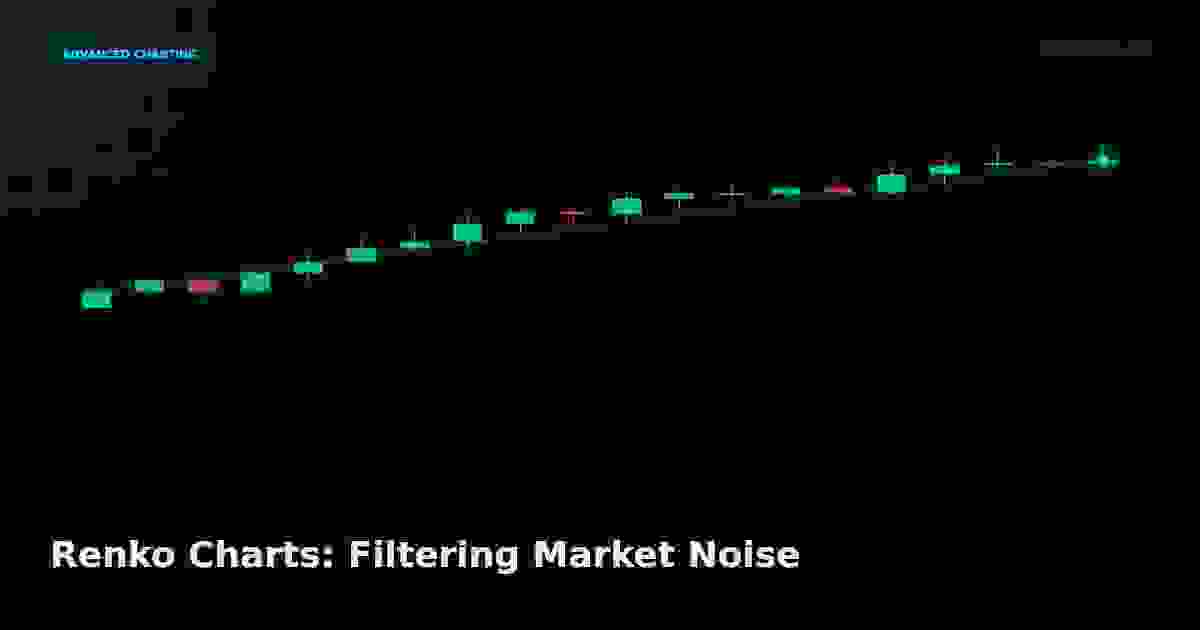
Renko charts strip time and small price moves out of the equation, leaving a clean trend picture built from bricks of fixed size.
Renko Charts: Filtering Market Noise
A Renko chart only prints a new brick when price moves a fixed amount. Time, gaps, and minor wiggles disappear — what remains is the trend.
Renko comes from the Japanese word renga, meaning "brick." Unlike candlesticks, which print a bar every interval whether price moved or not, a Renko brick appears only when price travels a defined distance. The result filters noise and exposes direction.
How Renko bricks are built
You set a brick size. A green brick prints when price rises that amount above the prior brick's close; a red brick prints when it falls that amount below. Bricks never share a row.
Common brick-size methods:
- Fixed points — e.g., 5 points on ES futures. Simple, ignores volatility.
- ATR-based — e.g., 1 × ATR(14). Adapts as markets quiet down or heat up.
- Percentage of price — useful for stocks of different prices.
Why traders use Renko
- Trend clarity: choppy ranges collapse; whipsaws shrink.
- Cleaner support and resistance: brick highs and lows line up tidily.
- Simpler stops: a brick flip is often the first sign of trend change.
The cost is information loss — you cannot see wicks, gaps, or how long price sat at a level. Renko is a trend tool, not a complete picture.
A simple Renko strategy
- Pick a brick size that matches your holding period (bigger bricks = longer trades).
- Wait for a green brick after a string of red — a basic reversal.
- Enter on the close of the first green brick.
- Stop loss just below the low of the prior red brick.
- Trail the stop one brick behind each new brick low (or high for shorts).
Avoid Renko during news events: spread widening creates artefact bricks that mislead.
Renko pitfalls
- Repainting: ATR-based brick size shifts historically. Always test on the data you'll trade.
- Late signals: waiting for the full brick gives up the first portion of every move.
- Dead markets: in flat sessions, no bricks print — you sit idle.
When Renko shines
Renko excels for trend-following swing traders who want to stay in trades until the trend actually flips. Pair it with a volume or momentum filter to avoid entering dead bricks.
Used right, Renko turns a noisy chart into a simple question: is price making higher bricks or lower bricks? Answer that, and you have a trading edge.
Live Chart
Open full chart →Related market data, powered by TradingView.
My Notes
Log in to save notes on this article and share them with the community.
Read next
Renko vs Kagi vs Line Break: Choosing the Right Alternative Chart
Renko, Kagi, and Three-Line-Break each filter noise differently, and matching the chart type to market regime, holding period, and instrument volatility produces measurably better trend reads than defaulting to one.
Read more →Smart Recommendations