No Demand and No Supply Signals in VSA
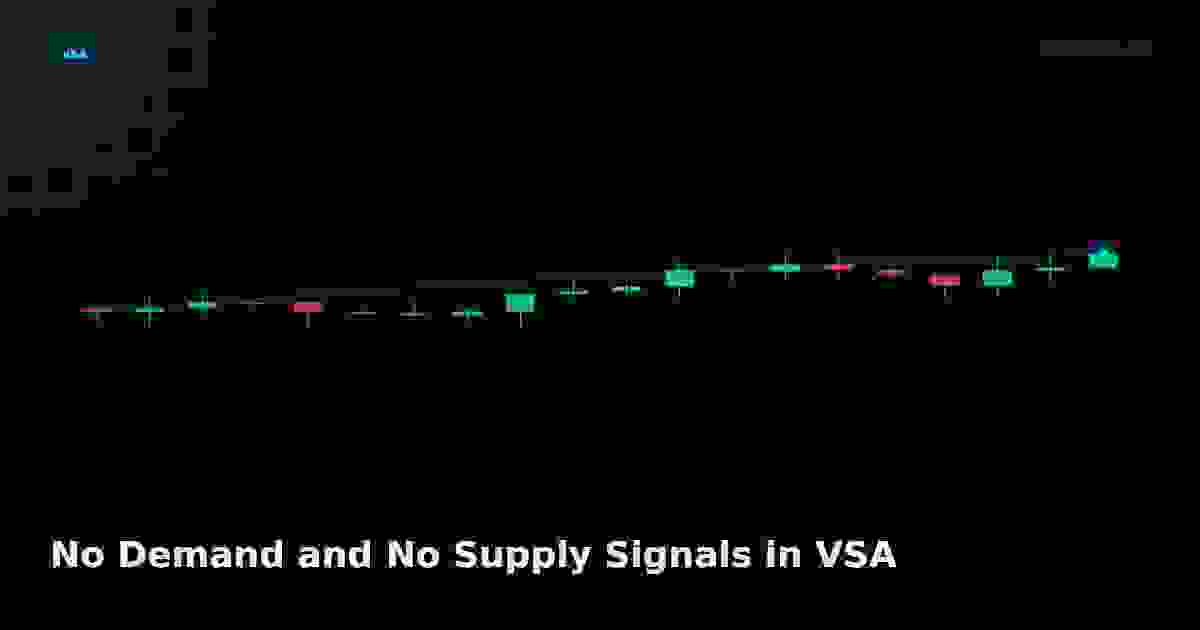
No Demand and No Supply are two of the most reliable VSA signals, marking the bars where professional interest disappears and the prevailing trend is about to fail.
No Demand and No Supply Signals in VSA
A trend dies not when it is attacked, but when it is abandoned.
Among all VSA patterns, No Demand and No Supply are the most frequently occurring and the easiest to spot. They mark the bars where professional money withdraws, exposing a trend that is running on fumes.
No Demand — the uptrend killer
The textbook No Demand bar appears after an up-move, on a narrow spread, with volume lower than the previous two bars. Price closes up, but weakly.
The interpretation: professionals have stopped buying. Without their participation, the rally has no engine. Retail buyers may push price a little higher, but the structure is fragile.
Confluence check: No Demand is far more reliable when it appears:
- After a clear rally (not in a base).
- At or near resistance.
- On a down bar immediately after an up bar.
- In the context of an overbought indicator read.
No Supply — the downtrend killer
The mirror image: after a down-move, a narrow-spread down bar with volume lower than the prior two bars. Price closes down but barely moves.
Interpretation: selling pressure has dried up. Professionals are no longer hitting bids. The downtrend is supported only by weak late sellers.
Confluence check:
- After an extended decline.
- Near support.
- In an oversold condition.
- With a bullish footprint bar following within one to two bars.
A side-by-side reference
| Signal | Trend context | Spread | Volume | Close |
|---|---|---|---|---|
| No Demand | Uptrend | Narrow | Lower than prior 2 | Up, weak |
| No Supply | Downtrend | Narrow | Lower than prior 2 | Down, weak |
How to trade them
Neither signal is a standalone entry. They are warnings. The correct use is:
- Spot the signal in context.
- Wait for confirmation — a down bar closing on its low after No Demand, or an up bar closing on its high after No Supply.
- Enter on the confirmation bar's close, with a stop beyond the signal bar's extreme.
The false signal trap
Beginners see narrow bars with low volume everywhere and call them No Demand. Context is everything. A narrow low-volume bar inside a trading range means nothing. The signal needs a prior trend and a position near a key level to have meaning.
Practice plan
Mark every No Demand and No Supply on a chart for the past six months, then check what price did over the next five bars. You will find that context-filtered signals reverse the trend roughly two-thirds of the time — a usable edge when combined with strict risk control.
Next: the climactic counterparts — stopping volume and the buying climax.
Live Chart
Open full chart →Related market data, powered by TradingView.
My Notes
Log in to save notes on this article and share them with the community.
Read next
Upthrust and Spring: Volume Confirmation Rules That Filter Fakes
Upthrusts and springs fail half the time on lower timeframes, but a three-part volume confirmation rule filters roughly two-thirds of false traps before you commit risk.
Read more →Smart Recommendations