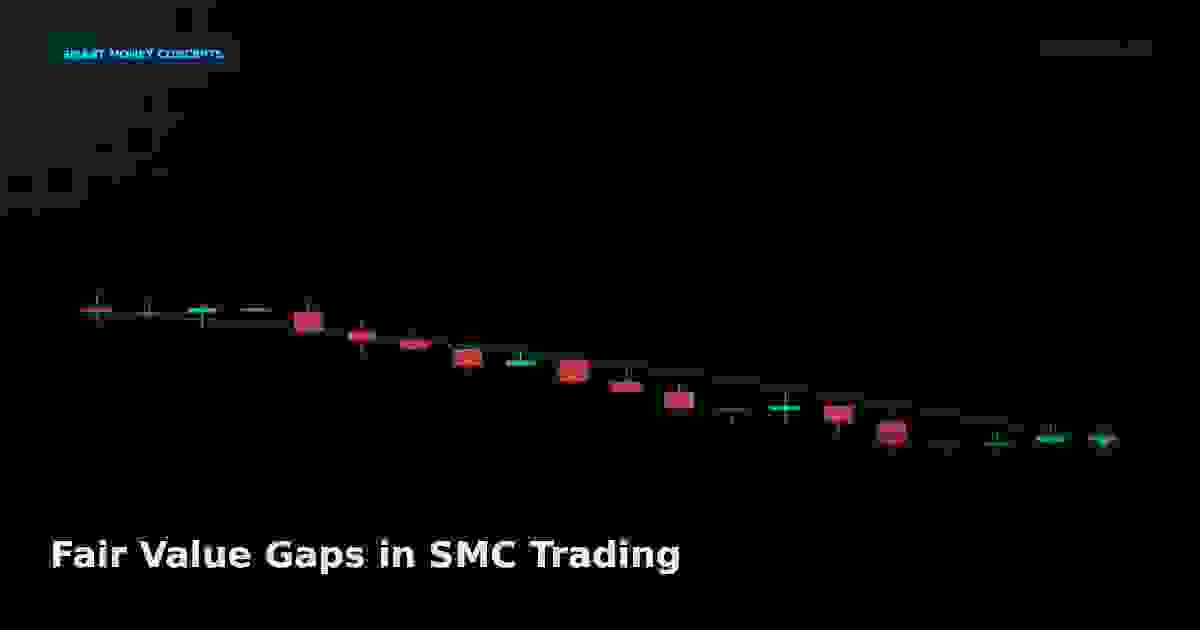
Fair Value Gaps in SMC Trading
Fair Value Gaps mark zones of imbalance where price moved too fast for the market to balance, and they often act as magnets for future price action.
Fair Value Gaps in SMC Trading
A Fair Value Gap (FVG) is a three-candle pattern that exposes imbalance. When price moves so aggressively that one candle's range does not overlap with the candle two positions later, a "gap" is left in the middle. SMC traders treat these gaps as zones the market tends to revisit.
The three-candle structure
An FVG is made of three consecutive candles:
- Candle 1: the candle before the impulse
- Candle 2: the large impulse candle
- Candle 3: the candle after the impulse
The gap exists between candle 1's wick (or body) and candle 3's opposite wick (or body). If there is no overlap between candle 1 and candle 3, the space between them is the FVG.
- Bullish FVG: gap above candle 1's high and below candle 3's low — price tends to return to fill it
- Bearish FVG: gap below candle 1's low and above candle 3's high — same logic, inverted
Why FVGs matter
Markets dislike imbalance. When price leaves a gap, it often returns to "fill" it — to rebalance the order flow before continuing. This gives traders a roadmap: if a strong move leaves an FVG behind, the next pullback often pauses or reverses at that gap.
FVGs are especially powerful when they align with other SMC elements — sitting inside an order block, near a liquidity pool, or at a premium/discount extreme.
How to trade FVGs
- Identify: find a strong impulsive move and confirm the three-candle gap
- Mark: draw a box from candle 1's relevant edge to candle 3's relevant edge
- Wait: let price return to the gap — do not chase the impulse
- Confirm: look for a lower-timeframe reaction inside the gap (engulfing, CHoCH, smaller FVG)
- Enter: with confirmation, target the next structural level or liquidity pool
FVG variants
- Runaway FVG: the gap never fills — the move is so strong price keeps going. Do not force a trade.
- Partial fill: price returns and fills part of the gap, then resumes. The unfilled portion is still valid.
- Consecutive FVGs: a chain of gaps signals a powerful trend. Each one is a potential pullback zone.
Common mistakes
- Marking every slight gap: small gaps on low timeframes are noise. Focus on gaps left by strong, obvious moves.
- Trading FVGs against the trend: a bullish FVG in a bearish trend is low-probability. Context rules.
- Entering without confirmation: price often slices straight through an FVG. Wait for a reaction.
- Forgetting stops: if price blows through the gap and keeps going, the setup is dead. Exit.
FVGs as confluence
The best use of an FVG is not as a standalone signal but as confirmation. An order block that contains an FVG is stronger than one without. A sweep that leaves an FVG on the reversal is more trustworthy than one without. Stack imbalances, and your probability rises.
Fair Value Gaps are simple to spot and remarkably consistent in their behavior. They are one of the most accessible entry points into SMC for traders coming from a traditional price-action background.
Live Chart
Open full chart →Related market data, powered by TradingView.
My Notes
Log in to save notes on this article and share them with the community.
Related
Read next
SMC Multi-Timeframe POI Filtering: From 200 Candidates to 3 A+ Setups
A repeatable filtering workflow to rank Points of Interest across timeframes, removing noise and isolating only HTF-aligned entries worth risking capital on.
Read more →Smart Recommendations