Rectangle Breakout and Retest Entry
Trade rectangle range breakouts with retest entries, volume confirmation, and measured-move targets to avoid false breakouts.
Rectangle Breakout and Retest Entry
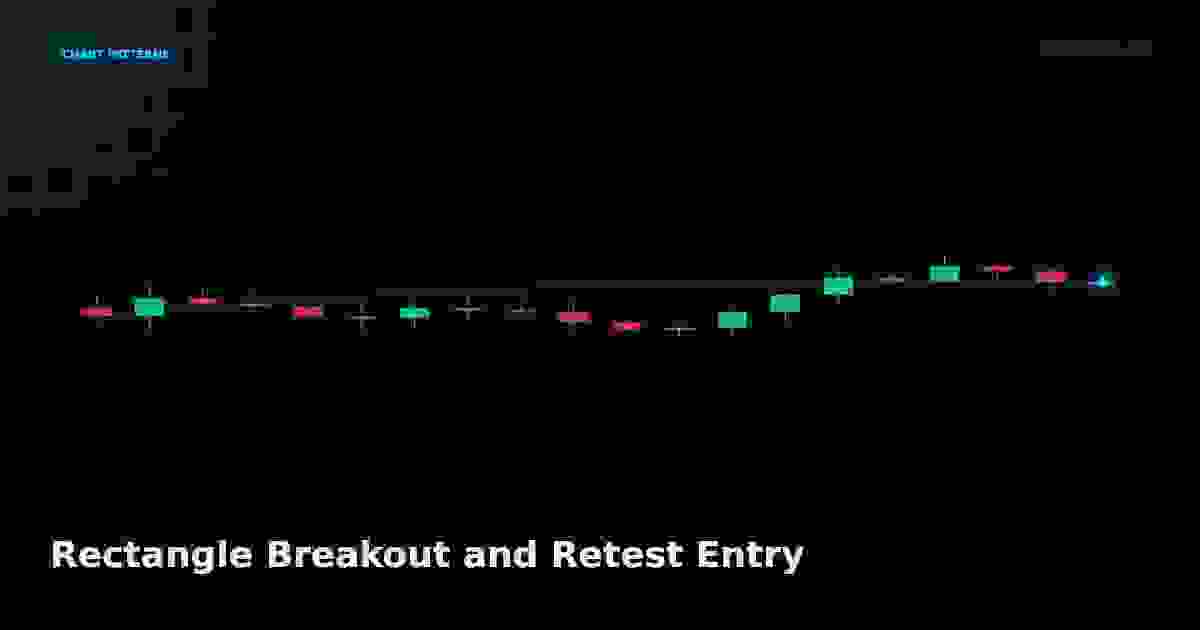
The rectangle is a horizontal range — price bounces between parallel support and resistance with no convergence. It is the simplest pattern and the most faked. The edge is in waiting for the retest, not chasing the break.
Pattern Identification
A valid rectangle requires:
- Two touches on support and two on resistance (minimum four reversal points).
- Parallel, horizontal boundaries (within 1-2% slope tolerance).
- Duration: 3-8 weeks on daily charts. Shorter = noise; longer = a different pattern.
- Volume: declining through the range. Rising volume inside a rectangle usually precedes the breakout direction.
Rectangles form in both trends (consolidation before continuation) and at major turns (distribution before reversal). Context — what preceded the rectangle — sets the bias.
Breakout Direction
In an uptrend, rectangles break up 65-70% (continuation). In a downtrend, down 65-70%. In a range-bound market, direction is a coin flip — trade the break, not the prediction.
The False Breakout Problem
Raw breakouts fail 40-50%. The first close outside the rectangle often reverses within 1-3 candles. Two filters cut false breakouts:
- Close outside the boundary, not just a wick.
- Volume on the breakout candle ≥ 1.5x the 20-day average.
With both filters, hit rate rises to 60-70%. Without volume, even a confirmed close fails 55%.
The Retest Entry
The highest-probability entry is the retest: after the breakout, price returns to the broken boundary (now support for an upside break, resistance for a downside break) and bounces.
Statistics: retest entries hit 65-75% vs. 55-65% for breakout entries. The cost: 25-35% of breakouts never retest — you miss those trades. The benefit: tighter stops, cleaner R:R.
Entry rules:
- Wait for the breakout close (filters applied).
- Wait for the retest: price returns to within 1% of the broken boundary within 5-10 candles.
- Enter on the first candle to close back in the breakout direction from the retest zone.
- Stop: beyond the retest wick, or back inside the rectangle. Tighter than the breakout-entry stop by 30-50%.
Target
Measured move: the height of the rectangle (resistance − support) projected from the breakout point. Example: rectangle from $50 to $60 (height $10), breakout at $60 — target $70.
Strong breakouts extend 1.5-2x the measured move. Take 50% at the measured move, trail the rest under a 20-day EMA or prior swing.
Stop Placement
- Breakout entry: stop back inside the rectangle (5-10% from entry).
- Retest entry: stop beyond the retest low/high (1-3% from entry). This is the retest's edge — same target, much tighter stop, better R:R.
Common Errors
- Chasing the breakout candle without the retest — lower hit rate, wider stop.
- Treating any range as a rectangle; require four clean touches.
- Stops exactly at the boundary — stop runs target it. Use 0.5% beyond.
Rectangle edge is patience. The break is the signal; the retest is the entry.
Live Chart
Open full chart →Related market data, powered by TradingView.
My Notes
Log in to save notes on this article and share them with the community.
Read next
Weekly and Monthly Pivots for Swing and Position Trading
Weekly and monthly pivots suit swing and position trading; monthly as filter, weekly as entry zones define holding, stop, and trailing rules.
Read more →Smart Recommendations