Heikin Ashi and Renko Pseudo-Candlesticks
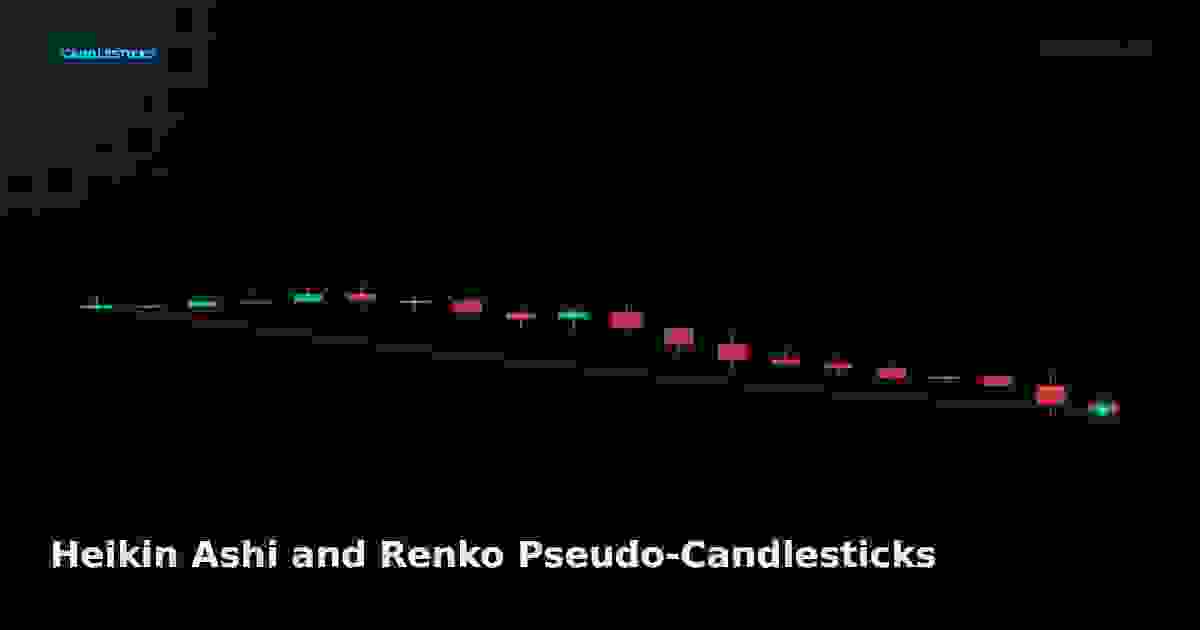
Heikin Ashi and Renko charts transform raw price into smoothed pseudo-candlesticks that filter noise but introduce distinct tradeoffs every trader must understand.
Heikin Ashi and Renko Pseudo-Candlesticks
Standard candlesticks render raw OHLC data directly — what you see is what happened. Heikin Ashi and Renko charts apply mathematical transformations to that data, producing "pseudo-candlesticks" that smooth noise and emphasize trend. These alternative charting methods have genuine analytical value, but they also introduce specific distortions that traders must understand before relying on them.
Heikin Ashi: The Smoothing Method
Heikin Ashi recalculates each candle using a modified formula:
Close = (Open + High + Low + Close) / 4Open = (prior Open + prior Close) / 2High = max(actual High, HA Open, HA Close)Low = min(actual Low, HA Open, HA Close)
The effect is a smoothed series where bull trends show mostly green candles with small lower wicks, and bear trends show mostly red candles with small upper wicks. The smoothing filters the noise of single-bar reversals, making trends visually cleaner.
Heikin Ashi Strengths
- Trend identification — a run of full-bodied HA candles in one direction is a clear trend signal that standard candles often obscure with chop.
- Pullback timing — a color change from green to red (or vice versa) after a run signals the first meaningful pullback, useful for trend-following entries.
- Noise reduction — in choppy markets, HA candles reveal the underlying direction more cleanly than raw candles.
Heikin Ashi Distortions
- No real price levels — the HA close is a synthetic average, not the actual close. Stops and targets cannot be placed using HA candles directly; the trader must reference standard candles for actual prices.
- Lag — the smoothing introduces lag. By the time HA confirms a reversal, the move may be partially complete.
- Wick masking — HA often hides the wicks that signal rejection in standard candles, removing useful information.
Renko: The Brick Method
Renko ignores time entirely. A new "brick" is drawn only when price moves by a fixed amount (the brick size) from the last brick. Up bricks are hollow or green; down bricks are solid or red. The result is a chart that filters out all sub-brick-size movement.
Renko Strengths
- Clean trend visualization — Renko removes sideways chop entirely, showing only meaningful moves.
- Support and resistance clarity — brick boundaries form clean horizontal levels.
- Backtesting simplicity — fixed brick size makes pattern recognition mechanical.
Renko Distortions
- Time removed — Renko hides how long a move took, which is often critical context.
- Brick size sensitivity — too small a brick produces excessive noise; too large misses real moves. The choice is subjective and affects every signal.
- Wick information gone — Renko has no wicks, so rejection intrabar is invisible.
- Repainting risk — bricks can be redrawn if price revisits a level, creating backtest illusions.
When to Use Each
Heikin Ashi suits traders who want cleaner trend visualization on existing timeframes and are willing to reference standard candles for execution levels. Renko suits traders focused on pure trend-following signals who accept the loss of time and wick information.
Neither replaces standard candlesticks. Both are overlays — lenses that reveal some features while hiding others. The advanced trader uses them selectively for specific analytical purposes and never mistakes the smoothed view for the underlying market.
The danger is treating pseudo-candlesticks as ground truth. They are transformations, not the market itself. Decisions made on transformed data must be reconciled with the raw price action that determines actual fills, stops, and profits.
Live Chart
Open full chart →Related market data, powered by TradingView.
My Notes
Log in to save notes on this article and share them with the community.
Read next
VaR and CVaR Calculation Methods and Their Limitations
VaR and CVaR calculation methods — historical, parametric, and Monte Carlo — with Python implementation and the specific limitations each method hides.
Read more →Smart Recommendations