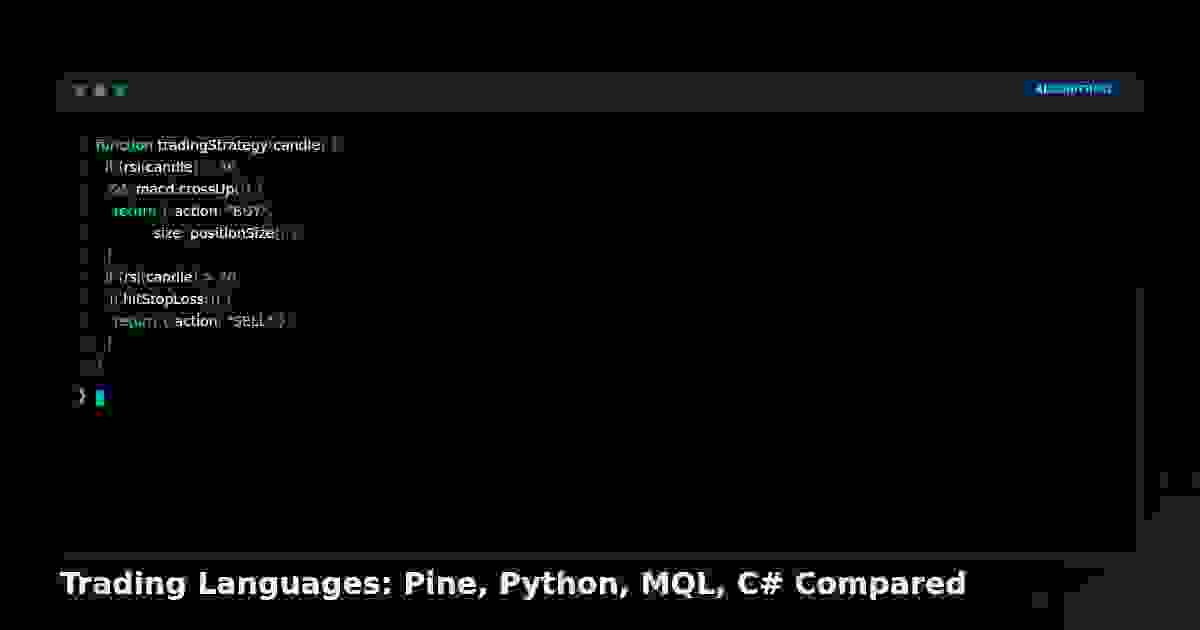
Trading Languages: Pine, Python, MQL, C# Compared
Different trading platforms speak different languages. Learn what Pine, Python, MQL, and C# are good at — and which one matches your goals.
Trading Languages: Pine, Python, MQL, C# Compared
The language isn't the edge. But picking the wrong one wastes months. Match the tool to the job.
New algo traders often agonize over which programming language to learn. The honest answer: it depends on what you're trying to do. Here's how the four most common trading languages compare.
Pine Script
The language of TradingView. Purpose-built for indicators and simple strategies.
- Strengths: instant chart visualization, zero setup, huge community library
- Weaknesses: limited data access, no real portfolio logic, hard to do serious ML, can't run outside TradingView
- Best for: idea prototyping, indicator design, simple long/short strategies
If you can describe your idea in Pine, you can usually test it in an afternoon.
Python
The lingua franca of quant research. Not a trading platform itself, but the ecosystem around it (pandas, numpy, backtrader, vectorbt) is unmatched.
- Strengths: pandas/numpy for data, scikit-learn and PyTorch for ML, any broker API, full backtesting libraries
- Weaknesses: slow for tick-level work, GIL limits true parallelism, you must build your own execution stack
- Best for: research, backtesting, factor analysis, ML, and connecting to broker APIs
Most serious retail quants end up here eventually.
MQL (MetaQuotes Language)
The native language of MetaTrader 4 (MQL4) and MetaTrader 5 (MQL5), the dominant retail FX platforms.
- Strengths: native to MT4/MT5, deep broker support in FX, easy automated execution
- Weaknesses: smaller ecosystem than Python, niche syntax, weaker ML support
- Best for: FX/CFD automated trading, EA (Expert Advisor) deployment
If your broker is MT4/MT5 and you trade FX, MQL is the practical choice.
C# (.NET)
Used by NinjaTrader, MultiCharts .NET, and many professional trading frameworks.
- Strengths: fast, strongly typed, real object-oriented design, supports complex event-driven strategies
- Weaknesses: steeper learning curve, more boilerplate than Python
- Best for: futures traders on NinjaTrader, performance-sensitive strategies, larger codebases
Comparison table
| Language | Setup time | Backtesting | ML | Execution | Best platform |
|---|---|---|---|---|---|
| Pine | Minutes | Built-in | None | TradingView | TradingView |
| Python | Days | Libraries | Excellent | Custom | Any broker |
| MQL | Hours | Built-in | Limited | Native | MetaTrader |
| C# | Days | Libraries | Good | Native | NinjaTrader |
How to choose
- Just prototyping ideas? Start with Pine Script
- Doing research or ML? Python
- Automating FX on MT4/MT5? MQL
- Automating futures on NinjaTrader? C#
You don't have to pick one forever. Most quants prototype in Pine or Python, then port execution-critical parts to whatever their broker supports.
Summary
There is no "best" trading language — only the right one for your platform and goal. Pine for prototyping, Python for research, MQL for FX automation, C# for futures and performance. Pick the one your broker and your current project demand, and don't waste energy on language wars.
Live Chart
Open full chart →Related market data, powered by TradingView.
My Notes
Log in to save notes on this article and share them with the community.
Read next
Quant Research Workflow: Jupyter Notebooks and Feature Engineering
A repeatable quant research workflow using Jupyter notebooks covers feature engineering, validation, and notebook hygiene that produces deployable signals.
Read more →Smart Recommendations