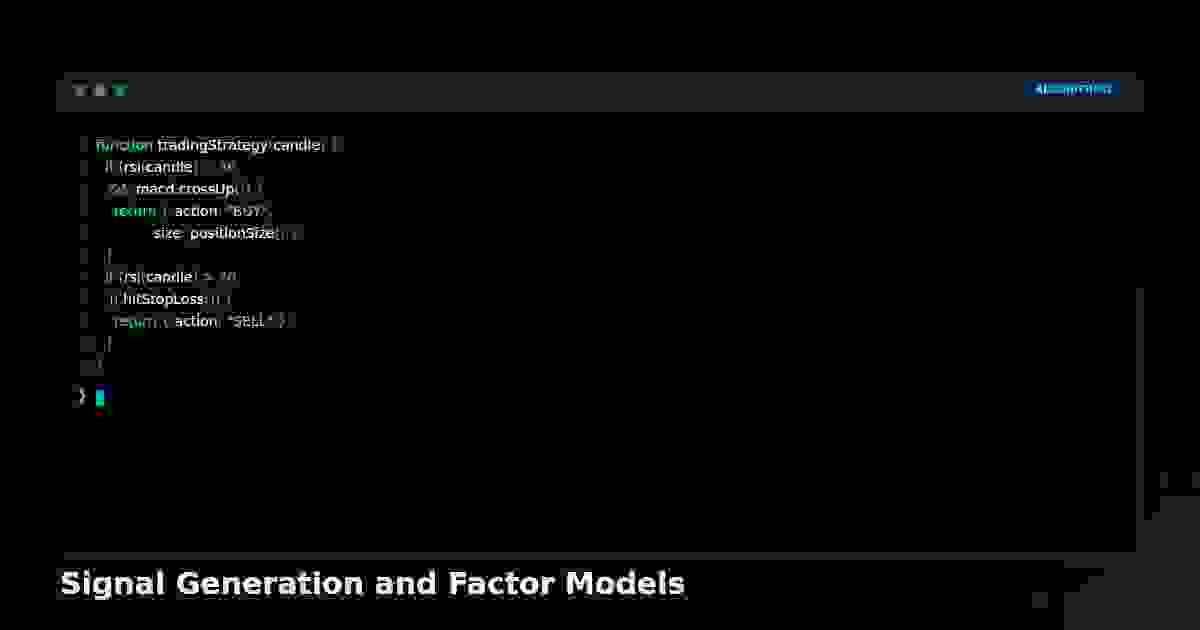
Signal Generation and Factor Models
Signals are the heart of any quant strategy. Learn what makes a good signal, how factor models organize them, and why most "signals" aren't.
Signal Generation and Factor Models
A signal is a number that says "buy this, sell that." A factor is a signal that explains returns across many assets and time. The difference matters.
Every quant strategy reduces to a signal: a function from market data to a position recommendation. Factor models go one step further, explaining why returns differ across assets. Together they form the architecture of nearly all systematic trading.
What makes a good signal
A signal must clear four bars:
- Predictive:
corr(signal_t, return_t+1) ≠ 0in a stable, sensible direction - Economic rationale: there must be a reason the signal works, not just a historical correlation
- Tradeable net of costs: the alpha must survive commissions, slippage, and market impact
- Robust: stable across out-of-sample windows, not just the training period
A signal with no economic story is a curve fit. It will work until it doesn't, with no warning.
The classic factor families
Academic finance identifies a handful of robust factors:
- Value: cheap vs expensive (e.g., book-to-market, earnings yield)
- Momentum: past 6–12 month returns predict future returns
- Size: small caps vs large caps
- Quality: profitability, low accruals, stable growth
- Low volatility: low-β stocks outperform on a risk-adjusted basis
- Carry: yield differentials in FX, fixed income, commodities
Each factor represents a behavioral or structural mispricing. Strategies are usually a blend of several, since diversification across factors lowers volatility.
Factor model structure
The standard linear factor model:
Ri = α + β1·F1 + β2·F2 + ... + βk·Fk + ε
Where each F is a factor return and βi measures the asset's exposure to that factor. Alpha is what's left after subtracting all factor exposures.
If your "alpha" disappears once you control for momentum and value, it was never alpha — it was just a factor exposure you didn't recognize.
Building a signal in practice
- Hypothesize the economic mechanism
- Engineer the feature: ratio, rank, z-score across the cross-section
- Cross-sectional rank assets each period; long the top decile, short the bottom
- Backtest the long-short portfolio with realistic costs
- Check factor exposure: regress against known factors to confirm you're not duplicating them
- Combine with other signals via inverse-variance or mean-variance weighting
Common traps
- Overfitting: 100 signals, you'll find 5 that look great by chance. Correct for multiple testing
- Capacity decay: a signal that worked on small caps may die when capital scales
- Crowding: popular factors (e.g., classic momentum) decay as more capital chases them
- Data leakage: using information not available at signal time
Summary
A signal is a prediction; a factor is an explanation. Build signals with economic stories, test them rigorously, and check their exposure to known factors before claiming alpha. Most "discoveries" are just repackaged beta — the rare, robust, uncorrelated signal is what real quant alpha is made of.
Live Chart
Open full chart →Related market data, powered by TradingView.
My Notes
Log in to save notes on this article and share them with the community.
Read next
Quant Research Workflow: Jupyter Notebooks and Feature Engineering
A repeatable quant research workflow using Jupyter notebooks covers feature engineering, validation, and notebook hygiene that produces deployable signals.
Read more →Smart Recommendations