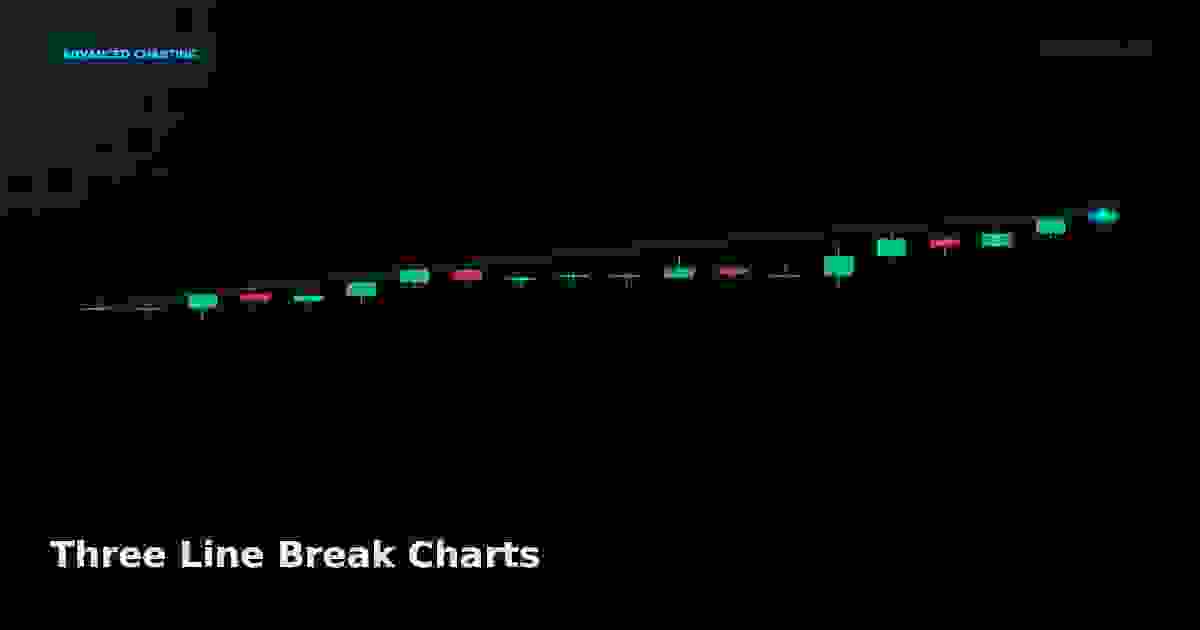
Three Line Break Charts
Three Line Break charts print reversals only when price exceeds the prior three lines, filtering out minor swings and isolating trend continuation.
Three Line Break Charts
A Three Line Break chart draws a new line only when price closes beyond the high or low of the prior three lines. Smaller moves don't print — the result is a trend filter that strips out everything but meaningful reversals.
Three Line Break (TLB) is a Japanese method, related to Renko and Kagi. It ignores time and volume — only price action that matters gets recorded. The "three" refers to the rule: a reversal requires breaking the extreme of the last three printed lines.
How Three Line Break works
- A green (white) line prints when price closes higher than the previous line's high.
- A red (black) line prints when price closes lower than the previous line's low.
- A reversal only happens when price exceeds the extreme of the prior three lines. Otherwise, the current trend continues.
If the prior three lines were all green and price drops below the low of the third-oldest line, a red line prints. The trend has flipped.
Reading a TLB chart
- Long string of same color = strong trend, stay with it.
- First reversal line after a long string = early trend change, watch closely.
- Bullish reversal = price exceeds the high of the prior three red lines, prints green.
- Bearish reversal = price breaks the low of the prior three green lines, prints red.
A TLB trend strategy
- Use TLB on the daily chart of an index or large-cap stock.
- Enter long after the first green reversal line following a red string.
- Stop loss: below the low of the reversal line.
- Exit: when a red reversal line prints (price broke the low of the prior three green lines).
This is a slow, trend-following approach. Expect few signals — sometimes one or two per quarter on daily charts.
Strengths and weaknesses
Strengths: eliminates whipsaws (most "reversal" candles never break the three-line threshold), clear visual (green and red strings are unmistakable), works across markets.
Weaknesses: late entries (waiting for a three-line break gives up the first portion of every trend), no intrabar detail (gaps, wicks, and intraday volatility are invisible), still whipsaws in choppy markets — just less often than candlesticks.
Choosing the line count
The default is three lines. A two-line break is more sensitive (more signals, more whipsaws); a four-line break is fewer signals, larger trends, later entries. Most traders stick with three — the original Japanese setting.
Combining TLB with other tools
- Use TLB for trend direction (only take longs during green strings).
- Use a candlestick chart on the same timeframe for entry timing.
- Add ATR for stop placement, since TLB lacks intrabar wick information.
Avoid TLB in low-priced, illiquid stocks where overnight gaps dominate. For traders chopped up by every small reversal candle, Three Line Break offers discipline: ignore anything that doesn't break three lines.
Live Chart
Open full chart →Related market data, powered by TradingView.
My Notes
Log in to save notes on this article and share them with the community.
Read next
Renko vs Kagi vs Line Break: Choosing the Right Alternative Chart
Renko, Kagi, and Three-Line-Break each filter noise differently, and matching the chart type to market regime, holding period, and instrument volatility produces measurably better trend reads than defaulting to one.
Read more →Smart Recommendations