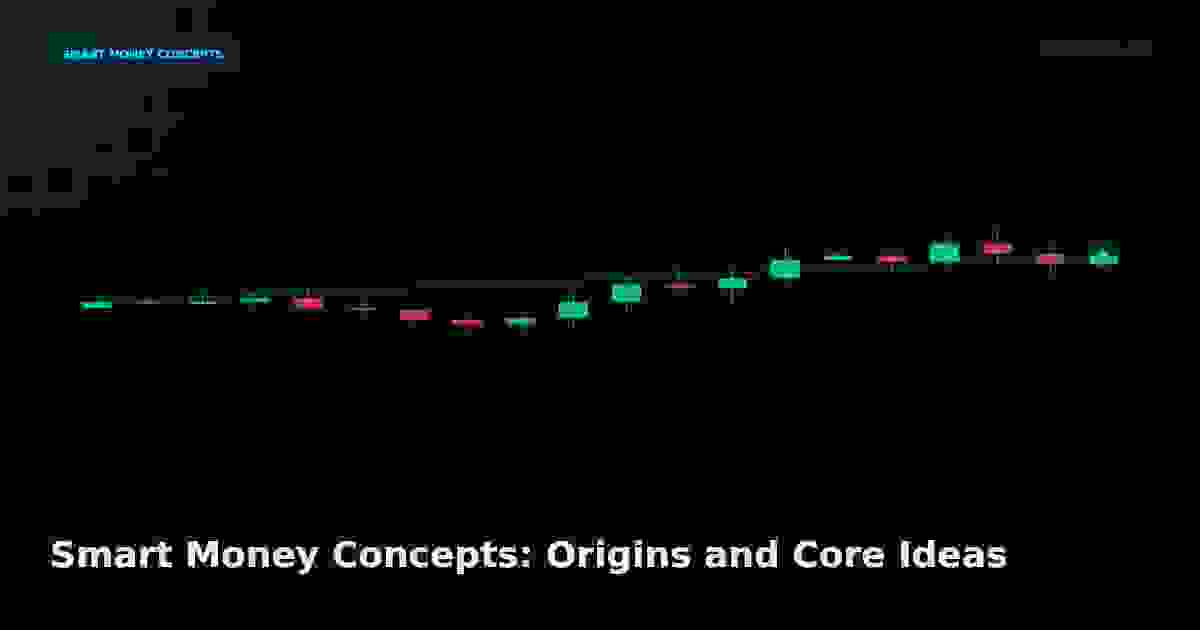
Smart Money Concepts: Origins and Core Ideas
Smart Money Concepts is a framework that maps how institutions move price, and this intro covers where it came from and what it actually claims.
Smart Money Concepts — Smart Money Concepts is a framework that maps how institutions move price, and this intro covers where it came from and what it actually claims.
Smart Money Concepts: Origins and Core Ideas
Smart Money Concepts (SMC) is a price-action framework built on a simple premise: markets are moved by large, informed participants — "smart money" — and retail traders can learn to follow their footprints instead of fighting them. Where classical TA draws lines and hopes, SMC maps where orders pool, where they get harvested, and where the next move begins.
Core concept: the four pillars of SMC
SMC packages decades of institutional order-flow theory — Wyckoff's early-1900s work, ICT's "London Open" strategies from the 2010s, and the supply-and-demand schools — into a vocabulary retail traders can use. Four pillars define it.
1. Price seeks liquidity. Every resting stop order is fuel. Institutions push price toward clusters of stops — above old highs, below old lows, round numbers — to fill large orders without slippage. Equal highs and equal lows are the most common liquidity pools.
2. Structure reveals control. Higher highs and higher lows mean bullish intent; the opposite means bearish. A break of structure (BOS) confirms the current move; a change of character (CHoCH) warns it may be ending.
3. Imbalance reveals intent. Strong one-sided candles leave gaps in price action called Fair Value Gaps (FVGs) — a 3-candle sequence where candle 1's high and candle 3's low don't overlap, leaving a gap in candle 2. FVGs mark where smart money committed aggressively and price tends to return to fill them.
4. Order blocks mark the origin. The last opposite-colored candle before a strong impulsive move is the order block (OB) — the zone where the move began and where unfilled institutional orders often still rest.
Example. Price sweeps below an old low at 1.2000 (liquidity grab), reverses sharply up with a 3-candle FVG between 1.2010 and 1.2025, the last bearish candle before the move (the bullish order block) sitting at 1.1990–1.2005. The SMC trader waits for price to retrace into the FVG/OB confluence and enters long, stop below 1.1990, targeting the next liquidity pool (equal highs) above.
Practical application: the SMC workflow
The standard SMC workflow is top-down and POI-driven:
- Mark the higher-timeframe (HTF) bias — daily/4H trend and the key liquidity pools (equal highs/lows, old swing highs/lows).
- Wait for a liquidity sweep or a clean BOS on the HTF that confirms or warns of direction.
- Drop to a lower timeframe (LTF) — e.g., 4H → 15M — and find a point of interest (POI): an order block or FVG in the direction of the HTF bias.
- Enter on confirmation — a LTF BOS or CHoCH at the POI — set the stop beyond the POI, and target the next liquidity pool.
Entry rules checklist:
- HTF bias clearly defined (HH/HL = long bias)
- POI marked: OB or FVG untested, or only lightly retested
- Price taps the POI on the LTF
- LTF confirmation: BOS in trade direction or CHoCH against the sweep
- Stop beyond the OB/FVG extreme (typically 5–15 pips beyond)
- Target the next liquidity pool; require R:R ≥ 2:1
- Risk per trade ≤ 1% of account
| SMC component | What it is | How to trade it |
|---|---|---|
| Liquidity pool | Equal highs/lows, old swings | Expect a sweep; trade the reclaim |
| BOS | Close beyond last HH/LL | Continuation entry on retest |
| CHoCH | Close beyond last HL/LH | Reversal warning; wait for confirm |
| Order Block | Last opposite candle before impulse | Enter on retest, stop beyond OB |
| FVG | 3-candle imbalance gap | Enter on return into gap |
Complete trade example. EURUSD daily uptrend; 4H shows a clean bullish OB at 1.0850–1.0865 (last bearish candle before a 60-pip impulse) with an FVG at 1.0858–1.0870 stacked inside it. Price retraces into the confluence on the 15M, sweeps the OB low to 1.0848, then prints a 15M CHoCH (breaks the most recent lower high at 1.0862). Entry 1.0862, stop 1.0843 (19 pips, beyond the OB low), target the equal highs at 1.0940 (78 pips). R:R ≈ 4.1:1. The HTF bias, the POI confluence, and the LTF confirmation each did their job.
Common mistakes
- Treating every opposite candle as an order block. Not every last-down candle before a move is a real OB — only the one before a strong, imbalanced impulse. Fix: require the move away to leave an FVG or break structure; without imbalance, the candle is just noise.
- Trading against the HTF bias. Taking a long LTF order block while the daily is making LH/LL is the classic SMC trap. Fix: HTF bias always wins; only take LTF POIs that align with the daily/4H direction.
- Entering on the POI with no LTF confirmation. Blindly limit-ordering into an OB often gets you swept. Fix: wait for a LTF BOS/CHoCH at the POI before entering — confirmation costs you a few pips but saves you from the sweep.
Advanced tips
- Stack POIs. The best entries are an OB, an FVG, and a key level all within 0.2 ATR — confluence multiplies edge.
- Time the liquidity sweep. SMC works best when the sweep happens at a session open (London/NY) with volume; Asian-session sweeps are lower quality.
- Validate OBs with volume. A real order block shows lower volume on the OB candle itself and a volume spike on the impulse away.
- Build on the structure foundation in Market Structure intro and BOS vs CHoCH; for the order-flow layer behind the prints, read Order Flow intro.
Summary
SMC reframes support and resistance as liquidity events and gives you a vocabulary — liquidity, BOS/CHoCH, order blocks, FVGs — to map where institutions act. Work top-down: define HTF bias, wait for a sweep or BOS, drop to a LTF POI, and enter on confirmation. It is a lens, not a guarantee — test it, risk-manage every trade, and let structure lead.
References
Live Chart
Open full chart →Related market data, powered by TradingView.
My Notes
Log in to save notes on this article and share them with the community.
Related
Read next
SMC Multi-Timeframe POI Filtering: From 200 Candidates to 3 A+ Setups
A repeatable filtering workflow to rank Points of Interest across timeframes, removing noise and isolating only HTF-aligned entries worth risking capital on.
Read more →Smart Recommendations