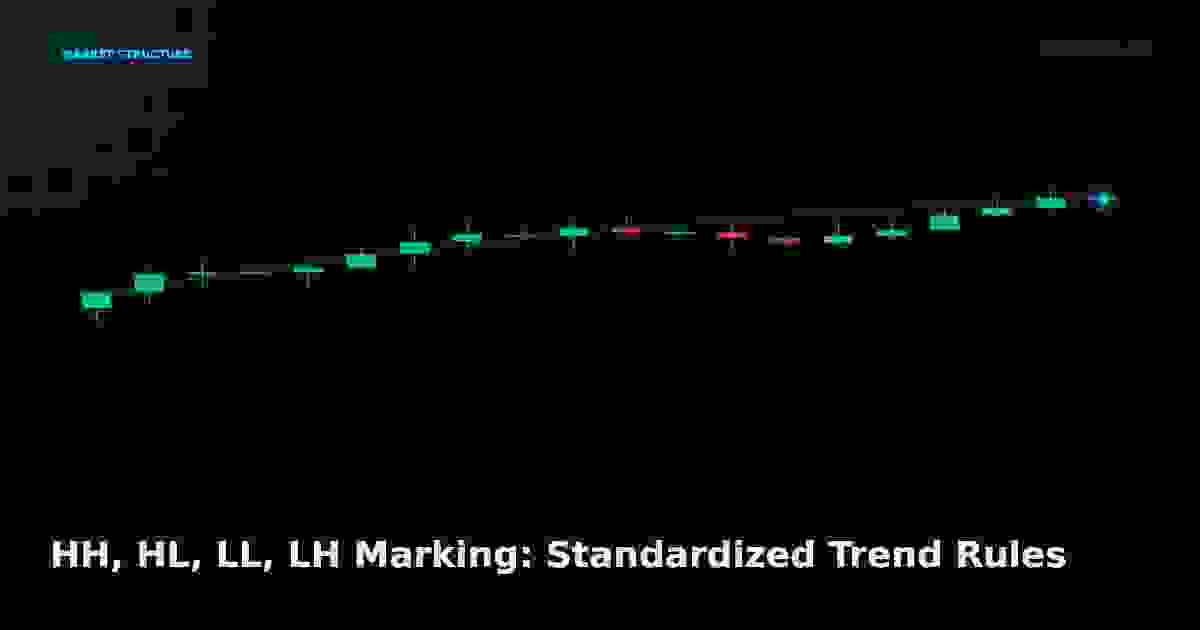
HH, HL, LL, LH Marking: Standardized Trend Rules
Standardized rules for marking higher highs, higher lows, lower lows, and lower highs — swing detection methods, major-swing filters, and multi-timeframe alignment.
HH, HL, LL, LH Marking: Standardized Trend Rules
The Higher High (HH), Higher Low (HL), Lower Low (LL), Lower High (LH) sequence is the foundation of market structure. Yet most traders mark them inconsistently, drawing swing points wherever it suits their bias. Standardized rules eliminate the subjectivity.
Rule 1: Define the swing detection method
Pick one of three methods and apply it uniformly:
- Fractal (5-bar): a swing high is a candle whose high is higher than the two candles on each side. Swing low is the mirror. Most common, works across timeframes.
- Fractal (3-bar): a swing high is higher than one candle on each side. More swings detected; noisier.
- Pivot high/low with close confirmation: the candle after the swing must close in the opposite direction. Cleaner, fewer false swings.
Use 5-bar fractals for daily and 4H; 3-bar fractals for H1 if you need more granularity. Never mix methods on the same chart.
Rule 2: Mark only major swings
Not every fractal is a structural swing. Filter to major swings using one of:
- ATR threshold: the swing's move from prior swing must be ≥ 1.5 ATR.
- Time threshold: at least 8 bars between major swings on the trading timeframe.
- Reaction threshold: the swing produced a counter-move of ≥ 1 ATR.
Without this filter, every minor ripple becomes a "swing" and the structure reads as chaos.
Rule 3: Define the trend from the sequence
- Uptrend: HH + HL sequence. Requires at least one HH and one HL after a prior low.
- Downtrend: LH + LL sequence. Requires at least one LH and one LL after a prior high.
- Range: mixed sequence — HH followed by LL, or LH followed by HL. No clear directional bias.
A single HH does not make an uptrend. Require two consecutive higher structures (HH + HL) to confirm trend change.
Rule 4: Re-mark on every structural break
When price breaks a prior swing (BOS or CHoCH), re-mark the structure. The new swing is now the reference. Holding onto pre-break structure is the most common structural error.
Rule 5: Use candle closes, not wicks, for break confirmation
A swing is "broken" when a candle closes beyond it, not when a wick pierces it. Wick-only breaks fail 60–70% of the time. Require close-confirmation for every structural break.
Rule 6: Multi-timeframe alignment
Mark structure on the trading timeframe AND one timeframe higher. Trade only when both agree:
- H4 uptrend (HH/HL) + H1 uptrend (HH/HL) → high-probability longs.
- H4 uptrend + H1 downtrend → wait for H1 to realign with H4 before entering.
- H4 range + H1 anything → trade only at range edges, never mid-range.
Counter-trend trades against the higher timeframe fail 60%+ of the time. Skip them unless at a major daily/weekly level.
Standardized marking turns subjective "I think it's an uptrend" into objective "H4 HH/HL sequence with BOS confirmation at 1.2050."
Live Chart
Open full chart →Related market data, powered by TradingView.
My Notes
Log in to save notes on this article and share them with the community.
Read next
Trend Strength Assessment: ADX, MA Slope, and Price Pace
Three independent measures of trend strength — ADX, moving average slope, and price pace — with strength-grade thresholds and position-sizing rules for each grade.
Read more →Smart Recommendations