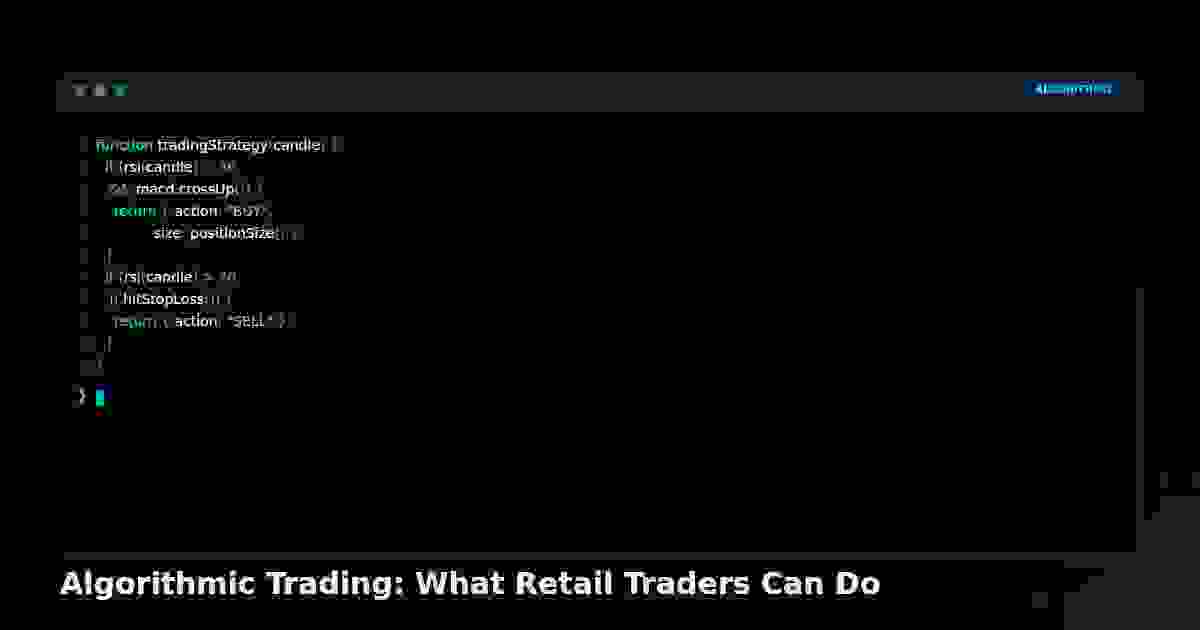
Algorithmic Trading: What Retail Traders Can Do
Algorithmic trading isn't just for hedge funds. Learn what retail traders can realistically automate, where the edges are, and where they are not.
交互工具在翻译视图中可能无法使用。
Algorithmic Trading: What Retail Traders Can Do
You will not beat a colocated HFT firm at its own game. But there are real edges retail algo traders can capture — if you pick the right ones.
The phrase "algorithmic trading" covers everything from a 15-minute bar script on TradingView to microsecond colocated market making. The retail trader's job is to understand where their edge can realistically live, and where it can't.
What "algorithmic" really means
An algorithm is just a deterministic set of rules executed by a computer. It can be:
- Signal-only: rules emit buy/sell alerts; you execute manually
- Semi-automated: signals fire, you confirm, the system places orders
- Fully automated: signal, risk check, execution, and position management all run without human input
Most retail algos live in the first two camps. Fully automated systems require serious infrastructure and risk controls — and they fail silently when something breaks.
Where retail edges actually exist
- Patience and discipline — algos don't FOMO or revenge-trade. Even a modest strategy automated well can beat a great strategy traded emotionally
- Multi-instrument monitoring — humans watch a few charts; algos watch hundreds
- Systematic risk management — fixed fractional sizing, automatic stops, no exceptions
- Higher timeframe strategies — swing and position trading where execution speed doesn't matter
- Cross-asset relative value — pairs, spreads, and basis trades that humans find tedious
Where retail edges do not exist
- Latency arbitrage — colocated firms win every time
- Pure market making — your fills and fees can't compete
- News-driven HFT — you'll be the liquidity, not the taker
- Tick-level stat arb on liquid equities — already crowded
A realistic retail stack
- A data source (exchange API, broker feed, or historical CSVs)
- A signal engine (Pine Script, Python, or a backtesting library)
- A backtester with realistic costs and slippage
- A paper-trading forward test of at least 2–3 months
- A broker API for execution
- Monitoring and kill switches for when (not if) something breaks
What to build first
Start with signal-only automation on a strategy you already trade manually. Get the rules crystallized, backtested, and forward-tested. Only once you trust the logic should you let the system place orders — and even then, with size caps and a manual override.
The honest truth
A retail algo's main advantage isn't speed or data — it's discipline and emotionless execution. Build for that. Don't try to compete on speed; compete on patience, risk control, and consistency over hundreds of trades.
Summary
Retail algorithmic trading is real and accessible, but only in certain niches. Automate discipline, risk management, and patience — not microsecond execution. Pick strategies where your lack of speed doesn't matter, build them carefully, and let the algorithm remove the parts of trading where humans fail: fear, greed, and inconsistency.
Live Chart
Open full chart →Related market data, powered by TradingView.