blog · ~6 min read

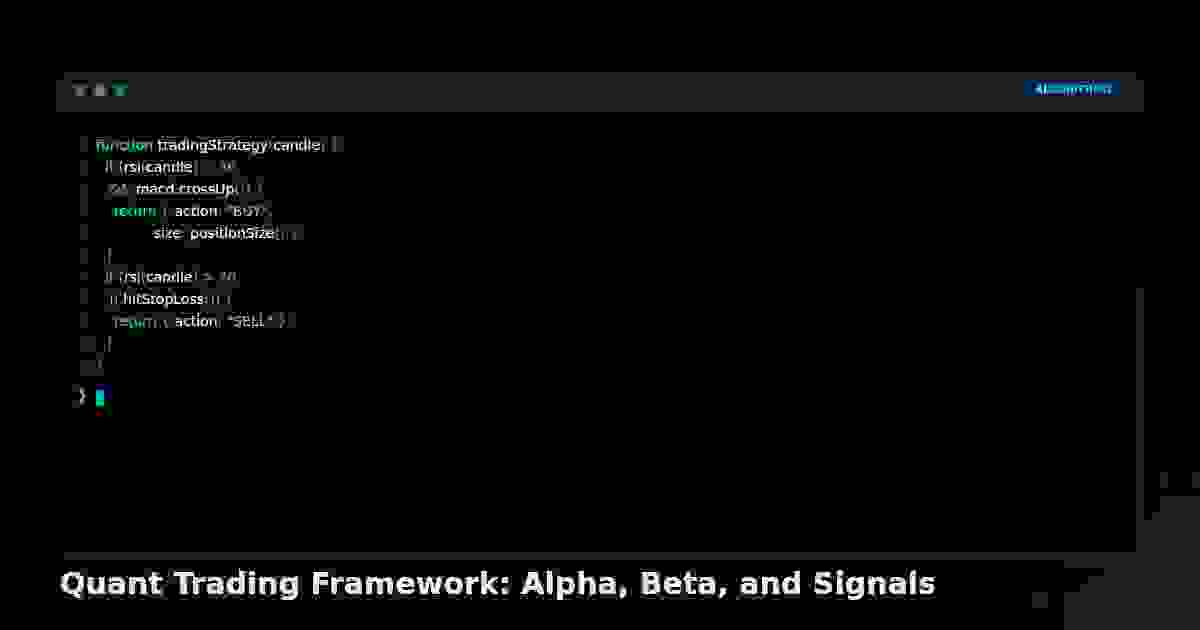
Quant Trading Framework: Alpha, Beta, and Signals

Every quant strategy reduces to the same framework: a signal that generates alpha, sized against beta. Learn the vocabulary that organizes all of quant trading.

T By tradernewbie · Curated for beginners
#algorithmic#quant-trading
本文为英文。需要查看中文翻译吗? Google 翻译 →

交互工具在翻译视图中可能无法使用。

Quant Trading Framework: Alpha, Beta, and Signals

In quant trading, "alpha" is the part of your return you can actually claim to have earned. Everything else is just beta — exposure anyone could have bought.

The language of quantitative trading is precise because it has to be. Without clear definitions of alpha, beta, and signal, you can't tell whether your strategy has edge or whether it's just riding a market you stumbled into.

Beta: the exposure you didn't choose

Beta measures an asset's sensitivity to the market:

Rp = α + β·Rm + ε

Where β is the slope from regressing your returns on the market's. A beta of 1.2 means your portfolio moves 1.2% for every 1% market move.

If your entire return comes from β, you haven't outperformed — you've just bought the market with leverage. Beta is cheap to obtain via index funds; it should not be the goal of an active strategy.

Alpha: the real edge

Alpha is the return above what beta explains:

α = Rp − β·Rm

True alpha is rare and decays. It comes from one of three sources:

  1. Information edge — you know something before others (increasingly hard)
  2. Analytical edge — you process public data better
  3. Behavioral edge — you exploit persistent mispricing from other traders' psychology

Most retail "alpha" is just beta in disguise. The honest test: does the strategy still make money in a flat or down market?

Signals: the trigger

A signal is a function of data that triggers a position. Formally:

Signal_t = f(features_t)
Position_t = g(Signal_t)

A signal must be:

  • Predictive — historically correlated with future returns
  • Tradeable — net of costs, slippage, and capacity
  • Independent — not just a restatement of another signal you already have
  • Robust — surviving out-of-sample, not just in-sample fit

The full quant workflow

  1. Hypothesize: form an economic reason a signal should predict returns
  2. Feature engineering: build the inputs from raw data
  3. Backtest: measure alpha net of realistic costs
  4. Risk-adjust: compute Sharpe, Sortino, max drawdown, beta to common factors
  5. Out-of-sample test: walk-forward or purged cross-validation
  6. Deploy small: live trade with reduced size
  7. Monitor decay: alpha erodes; watch the rolling Sharpe

The capacity constraint

Alpha isn't infinite. Every strategy has a capacity — the maximum capital it can deploy before its own orders move the market enough to kill the edge. Retail-scale strategies often die the moment real money flows in.

Summary

Beta is what you get for free by owning the market. Alpha is what you earn by being smarter. Signals are how you generate alpha. Build the framework around these definitions, always ask "is this alpha or just beta?", and you'll think about strategy the way real quants do — instead of just hoping your backtested curve keeps climbing.

Related market data, powered by TradingView.

Educational content · Not financial advice · Trade at your own risk