Order Flow Imbalance and Reversal Signals
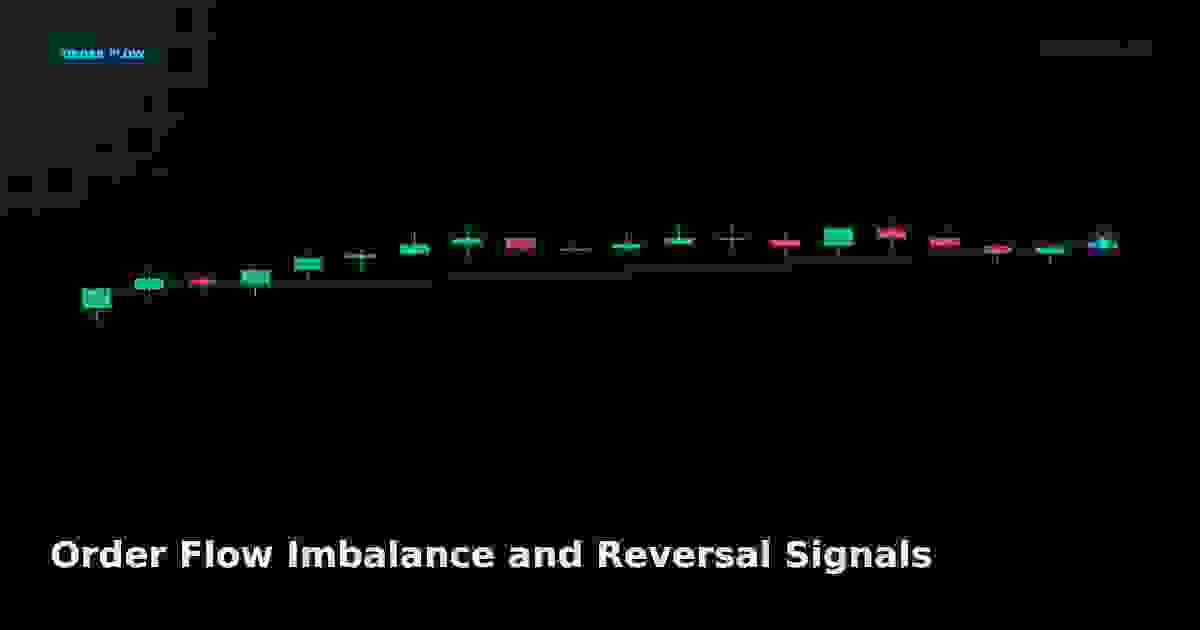
Order flow imbalances — repeated one-sided aggression at a price — reveal where supply or demand overwhelmed the other side, often marking the start or end of a move.
交互工具在翻译视图中可能无法使用。
Order Flow Imbalance and Reversal Signals
A balanced market rotates. An imbalanced market breaks out. The transition between them — the moment aggression shifts from one side to the other — is where the cleanest reversal signals appear.
Order flow imbalance occurs when one side (buyers or sellers) consistently out-aggresses the other at a specific price or over a short window. Spotting imbalances, and especially spotting when they stop, is one of the highest-edge skills in order flow trading.
What an imbalance is
In footprint charts, an imbalance is typically defined as a price level where one side's volume is at least 3× the other's. A cell showing 100 bid volume / 350 ask volume is a buy imbalance — aggressive buyers overwhelmed sellers at that price.
A stacked imbalance is three or more consecutive price levels all showing imbalances in the same direction. Stacked imbalances are walls of aggression — strong support or resistance.
Three types of imbalance signals
1. Initiation imbalance (trend start)
A cluster of buy imbalances forms as price breaks above a level. Delta turns strongly positive, volume rises through the breakout zone. The breakout has real backing. Trade: enter with the break on the first pullback. Stop below the breakout level. Target the next HVN.
2. Exhaustion imbalance (trend end)
Price makes a new extreme with heavy one-sided aggression, but the aggression stalls — imbalances shrink or stop, volume falls off above/below the extreme. The move has no more fuel. Trade: fade the next test of the extreme. Stop beyond the extreme. Target the candle's POC or prior swing.
3. Absorption imbalance (reversal setup)
Heavy aggressive selling into a support level, but price stops falling. Footprint shows large volume at the low with delta turning positive (buyers absorbed the sells). The aggressive side got absorbed. Trade: enter long on the close of the absorbing candle. Stop below the low. Target the prior swing high.
The reversal signal: three confirmations
A high-probability reversal requires three confirmations. Single signals are noise; triples are trades.
- Exhaustion at the extreme: price makes a new high/low, but imbalances shrink, volume drops, tape shows opposite-side prints dominating.
- Absorption at the level: high total volume, delta flips against the move (e.g., negative delta at a new high — sellers absorbed the breakout), footprint shows stacked imbalances against the move.
- Reversal price action: a candlestick prints against the move — engulfing candle, pin bar, or lower close after a new high.
When all three align, enter against the prior move. Stop beyond the extreme. Target the candle's POC, prior swing, or next HVN.
Common mistakes
- Fading every imbalance: most imbalances are continuation signals, not reversals. Only fade when exhaustion + absorption + reversal candle align.
- Ignoring higher timeframe: a 5-minute reversal against a strong daily uptrend is a scalp, not a swing.
- Treating imbalances as infallible: institutions can overwhelm absorption. Use stops.
Live Chart
Open full chart →Related market data, powered by TradingView.