blog · ~6 min read

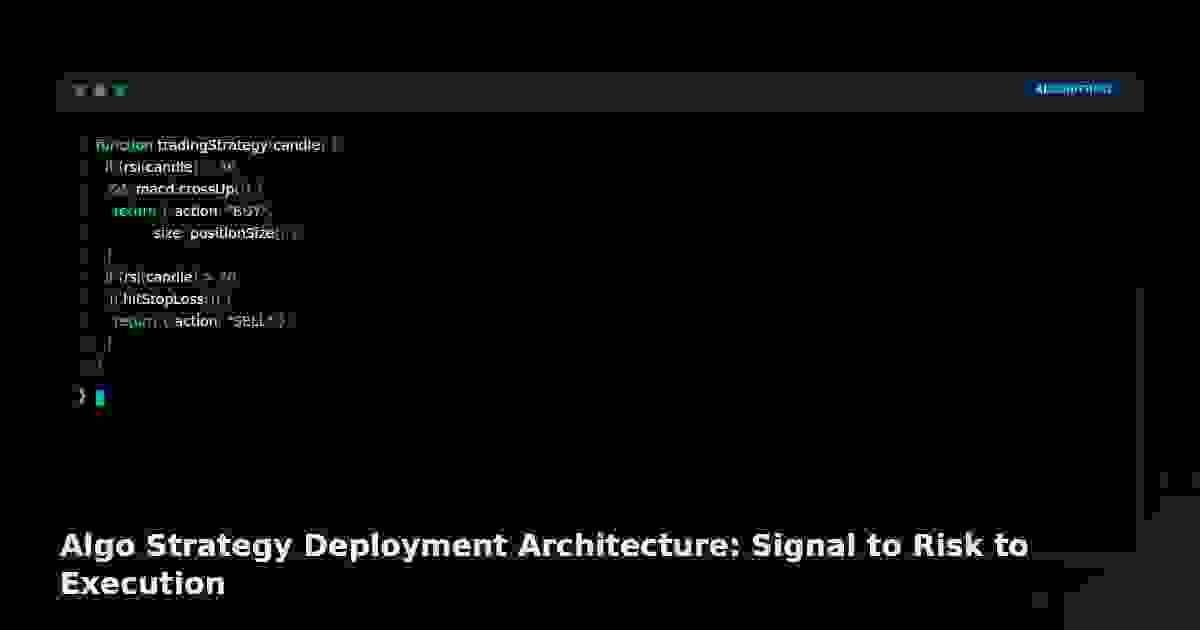
Algo Strategy Deployment Architecture: Signal to Risk to Execution

A production algo deployment architecture separating signal generation, risk gates, and execution, with concrete components and data flow for live trading.

T By tradernewbie · Curated for beginners
#algorithmic#quant-trading
本文为英文。需要查看中文翻译吗? Google 翻译 →

交互工具在翻译视图中可能无法使用。

Algo Strategy Deployment Architecture: Signal to Risk to Execution

A profitable backtest is not a deployable system. The gap between them is architecture. A live algo needs four loosely coupled stages — signal, risk gate, order router, and reconciliation — each independently testable and killable.

The four-stage pipeline

1. Signal engine. Produces target positions: a vector of {symbol, side, size, confidence} at each decision tick. Keep it stateless beyond indicator history. A signal module that knows about fills or cash is a coupling bug.

2. Risk gate. The only stage allowed to veto. It checks, in order:

  • Position size ≤ 1% account risk
  • Gross exposure ≤ 100% (or your leverage cap)
  • Net sector exposure within limits
  • Max daily loss not breached (halt if drawdown > 3%)
  • Correlation budget: combined risk of open positions ≤ 6%

If any check fails, the order is rejected and logged. The risk gate must be the last code that touches the order before the router.

3. Order router. Translates target positions into broker orders. Handles smart order routing, slicing (TWAP/VWAP for size > 5% of 1-minute volume), and venue selection. It must never compute position size — that is the signal engine's job.

4. Reconciliation. A separate process compares broker-reported fills against internal expected fills every 60 seconds. Mismatches > 0.05% trigger an alert; mismatches > 0.5% trigger a flat-all.

Data flow and decoupling

Connect stages with a message queue (Redis, ZeroMQ) rather than direct function calls. This lets you restart the signal engine without dropping an order mid-flight, and lets the risk gate run on dedicated hardware.

The kill switch

Every system needs a hardware-level kill: a single command that cancels all open orders and flattens positions. Bind it to a physical button and to a watchdog that triggers it automatically if the signal engine stops emitting heartbeats for 30 seconds. Most blowups happen when a frozen process leaves stale orders live.

Deployment checklist

  • Heartbeat every 5 seconds from each stage, logged centrally
  • Clock sync via NTP; order timestamps drift otherwise
  • Idempotent order submission with client_order_id to prevent duplicates on reconnect
  • Separate paper and live configs by environment variable, never by comment toggle
  • Daily reconciliation report comparing realized PnL to expected PnL from the signal log

Common architecture failures

Monolithic scripts that mix signal and execution cannot be restarted safely and cannot be audited. A 200-line "do everything" bot works until the first reconnect, then double-fills. Split the pipeline on day one; the cost is a few hundred lines, the benefit is surviving your first outage.

Related market data, powered by TradingView.

Educational content · Not financial advice · Trade at your own risk