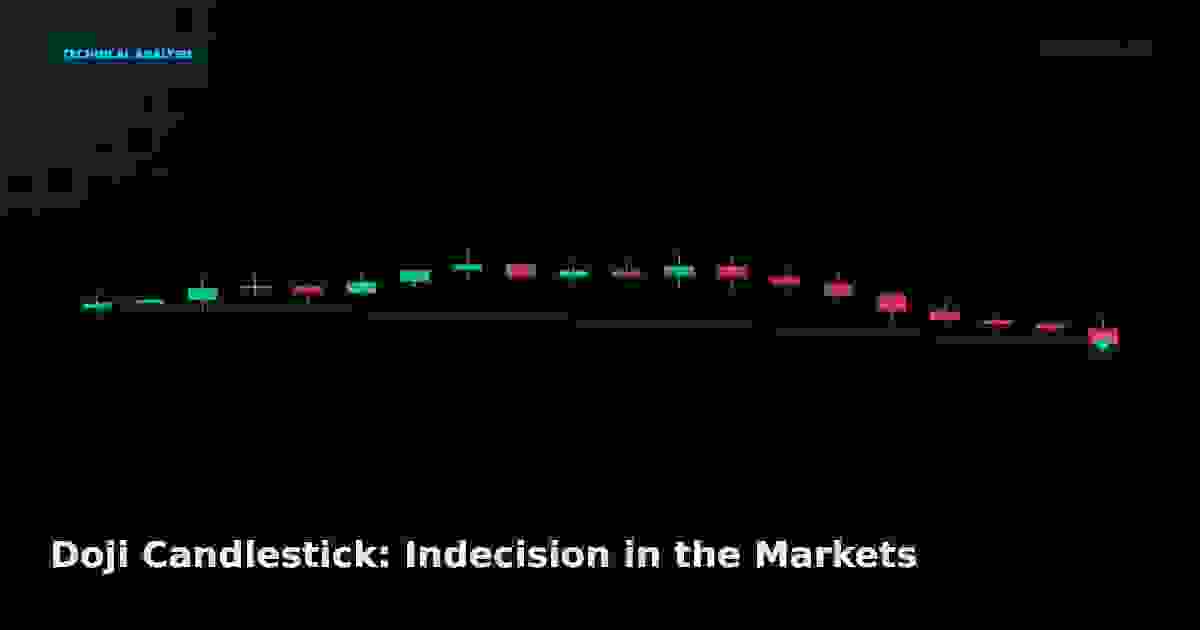
Doji Candlestick: Indecision in the Markets
The doji candlestick signals market indecision when buyers and sellers reach equilibrium.
What Is a Doji Candlestick?
The doji is a single-candlestick pattern that forms when a security's open and close prices are virtually identical. The result is a candle with little or no body, appearing as a thin horizontal line, often with wicks (shadows) extending above and below it. The name comes from the Japanese word for "mistake" or "blunder," reflecting the uncertainty it represents.
What the Pattern Looks Like
A classic doji has these visual characteristics:
- A nearly flat body (open and close are equal or very close)
- Upper and lower shadows of varying lengths
- Resembles a cross or plus sign (+)
There are several variations, including the long-legged doji (long wicks on both sides), the dragonfly doji (long lower shadow, no upper shadow), and the gravestone doji (long upper shadow, no lower shadow).
What It Signals
The doji represents indecision in the market. After a move in either direction, a doji suggests that the balance between buyers and sellers has stalled. On its own, a doji is not a strong reversal signal, but when it appears after an extended uptrend or downtrend, it can hint at a potential shift in direction.
| Context | Interpretation |
|---|---|
| After an uptrend | Possible reversal to the downside |
| After a downtrend | Possible reversal to the upside |
| In a sideways range | Continuation of consolidation |
How to Trade It
- Wait for confirmation. Never trade a doji alone. Look for the next candle to confirm direction — a bearish candle after an uptrend doji strengthens the reversal case.
- Combine with support/resistance. A doji at a major resistance level after an uptrend is far more meaningful than one in the middle of a range.
- Use volume. A doji on high volume carries more weight than one on low volume, indicating active struggle between bulls and bears.
- Set stop-losses above the doji's high (for short entries) or below its low (for long entries) to manage risk.
Common Mistakes to Avoid
- Treating every doji as a reversal signal
- Ignoring the broader trend context
- Entering before confirmation arrives
The doji is best used as a warning that momentum is fading, not as a standalone trade trigger. Pair it with other patterns and indicators for the highest-probability setups.
Live Chart
Open full chart →Related market data, powered by TradingView.
My Notes
Log in to save notes on this article and share them with the community.
Related
Read next
Trendline Drawing Standardization: Touch Points, Angle, and Confirmation
Standardized rules for drawing trendlines — touch point selection, ideal angle bands, minimum touches, breakout confirmation, and common curve-fitting errors to avoid.
Read more →Smart Recommendations