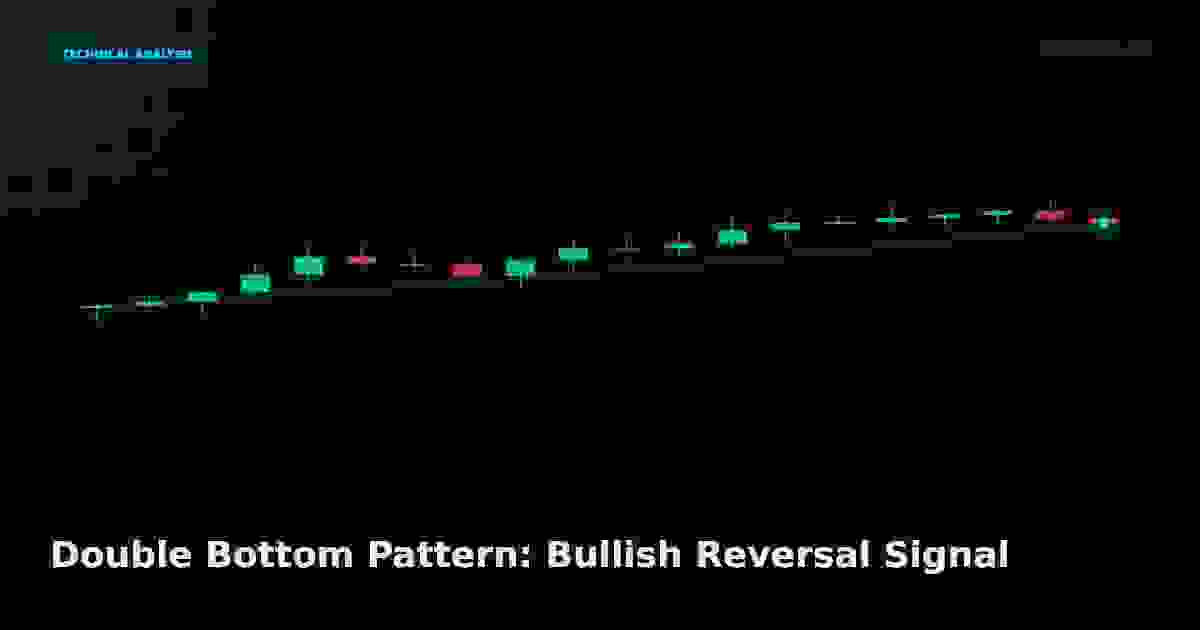
Double Bottom Pattern: Bullish Reversal Signal
The double bottom is a bullish reversal chart pattern that forms after a downtrend and signals a potential trend change.
What Is a Double Bottom Pattern?
The double bottom is a bullish reversal chart pattern that appears after a downtrend. It resembles the letter "W" on a chart and signals that sellers have failed twice to push price below the same support level. The pattern suggests that the downtrend has exhausted itself and a reversal to the upside is likely.
What the Pattern Looks Like
The double bottom consists of two troughs at roughly the same price level, separated by a moderate bounce:
- First trough: Price reaches a low and bounces
- Peak: A moderate rally between the two troughs
- Second trough: Price falls back to the same level but fails to break lower
- Neckline: The resistance level at the peak between the two troughs
The two troughs should be close in price — within a few percent of each other. The pattern is only confirmed when price breaks above the neckline.
What It Signals
The double bottom signals that sellers failed twice at the same support level. Each failed attempt to break lower shows weakening supply, and the eventual break above the neckline confirms that buyers have taken control.
The pattern is only complete when price closes above the neckline. Before that, it's only a setup.
How to Trade It
- Identify the two troughs at roughly the same support level.
- Wait for the neckline break. Enter long when price closes above the peak between the two troughs.
- Place your stop-loss below the second trough.
- Measure the target. The expected rally equals the distance from the troughs up to the neckline, projected upward from the breakout point.
Trading Example
A stock falls from $60 to $40, bounces to $46, then falls back to $40 but fails to break lower. The neckline sits at $46. When price breaks above $46, traders enter long with a stop below $40. The target is $46 - $40 = $6, projected up from $46 to give a target of $52.
Common Mistakes
- Entering before the neckline breaks
- Treating minor bounces as confirmed double bottoms
- Ignoring volume — the second trough should ideally form on lower selling volume, and the breakout should happen on higher buying volume
Comparison: Double Bottom vs. Double Top
| Feature | Double Bottom | Double Top |
|---|---|---|
| Trend context | After downtrend | After uptrend |
| Signal type | Bullish reversal | Bearish reversal |
| Shape | W | M |
When to Be Cautious
Double bottoms are less reliable in strongly trending markets where sellers may eventually break through support. Always weigh the signal against the broader trend context before going long.
The double bottom is popular among swing traders because it offers clear entry, stop-loss, and target levels, and tends to produce reliable reversals when confirmed at major support.
Live Chart
Open full chart →Related market data, powered by TradingView.
My Notes
Log in to save notes on this article and share them with the community.
Related
Read next
Triangle Breakouts: Probability by Type
Compare ascending, descending, and symmetrical triangle breakout probabilities with volume filters and target-measurement rules.
Read more →Smart Recommendations