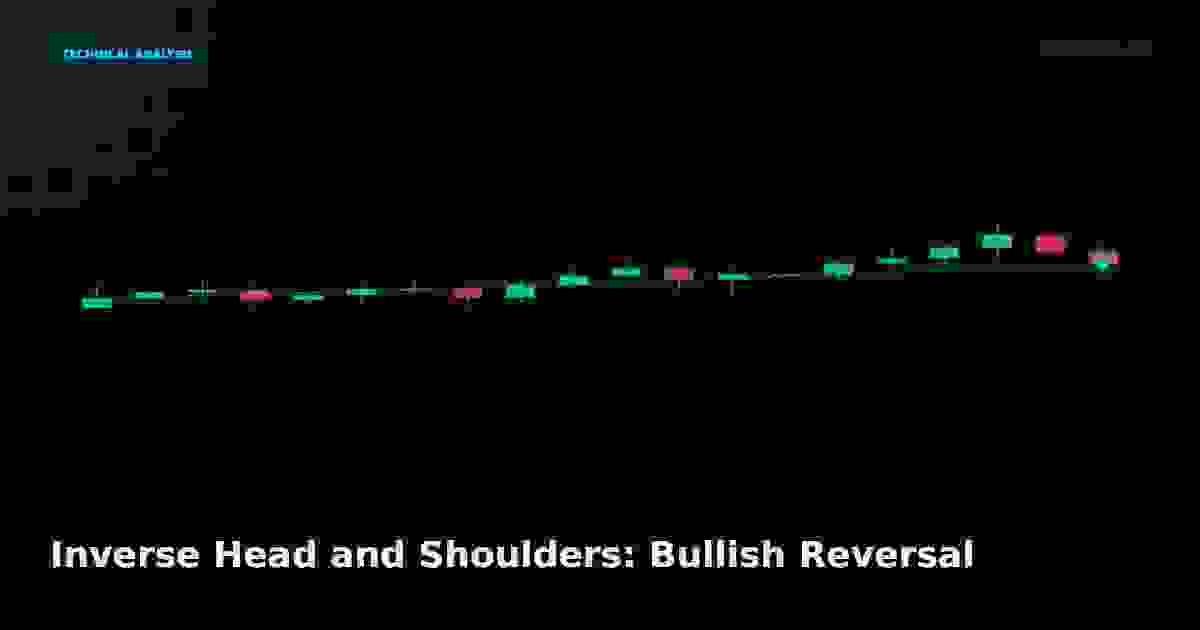
Inverse Head and Shoulders: Bullish Reversal
The inverse head and shoulders is a bullish reversal pattern that signals a trend change from bearish to bullish.
What Is the Inverse Head and Shoulders Pattern?
The inverse head and shoulders (also called the head and shoulders bottom) is a bullish reversal chart pattern that appears after a downtrend. It's the bullish counterpart to the classic head and shoulders pattern. The formation resembles an upside-down head with two shoulders, signaling that sellers are losing control and a new uptrend may be beginning.
What the Pattern Looks Like
The inverse head and shoulders consists of four components:
- Left shoulder: A trough formed during the downtrend
- Head: A lower trough that forms the bottom of the pattern
- Right shoulder: A higher trough that doesn't fall as low as the head
- Neckline: A resistance line connecting the highs between the shoulders and head
The neckline can be horizontal or sloped. An upward-sloping neckline is considered more bullish because it shows sellers accepting higher resistance levels.
What It Signals
The inverse head and shoulders signals that each successive decline is weaker than the last. The higher right shoulder shows sellers can no longer push price to new lows, indicating exhaustion of the downtrend. Once the neckline breaks, the pattern is confirmed.
The pattern is only complete when price closes above the neckline. Before that, it's only a setup.
How to Trade It
- Identify all four components — left shoulder, head, right shoulder, neckline.
- Enter on the neckline break. Go long when price closes above the neckline.
- Place your stop-loss below the right shoulder.
- Measure the target. The expected move equals the distance from the head's low up to the neckline, projected upward from the breakout point.
Trading Example
A stock falls from $60 to $40, forms a left shoulder at $42, a head at $38, and a right shoulder at $43. The neckline sits at $48. When price breaks above $48, traders enter long with a stop below $43. The target is $48 - $38 = $10, projected up from $48 to give a target of $58.
Common Mistakes
- Entering before the neckline breaks
- Drawing the neckline incorrectly (it must connect the highs between shoulders)
- Ignoring volume — the right shoulder should ideally form on lower selling volume, and the breakout should happen on higher buying volume
Comparison: Inverse vs. Classic Head and Shoulders
| Feature | Inverse | Classic |
|---|---|---|
| Trend context | After downtrend | After uptrend |
| Signal type | Bullish reversal | Bearish reversal |
| Entry trigger | Neckline break up | Neckline break down |
The inverse head and shoulders is favored by swing traders and position traders because it offers clear entry, stop-loss, and profit target levels based on measurable pattern geometry, often producing some of the highest-probability long setups in technical analysis.
Live Chart
Open full chart →Related market data, powered by TradingView.
My Notes
Log in to save notes on this article and share them with the community.
Related
Read next
Triangle Breakouts: Probability by Type
Compare ascending, descending, and symmetrical triangle breakout probabilities with volume filters and target-measurement rules.
Read more →Smart Recommendations