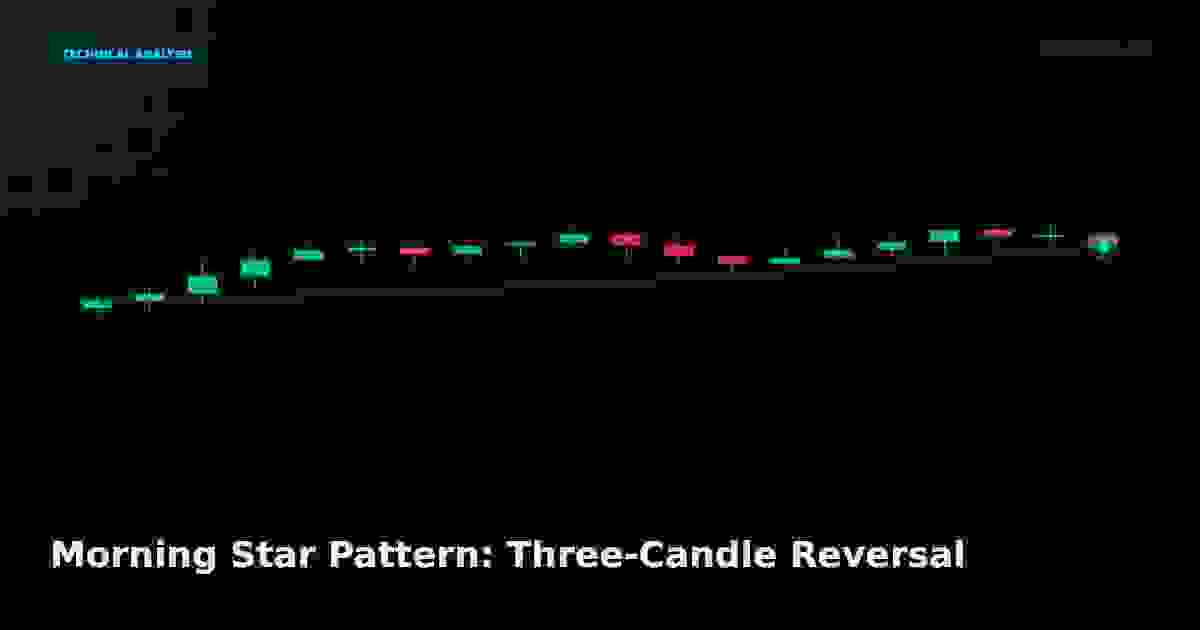
Morning Star Pattern: Three-Candle Reversal
The morning star is a three-candle bullish reversal pattern that forms at the bottom of a downtrend.
What Is the Morning Star Pattern?
The morning star is a three-candle bullish reversal pattern that appears at the end of a downtrend. Named after the planet Venus visible just before sunrise, it signals the dawn of a new upward move. The pattern shows a gradual transition from bearish control to bullish control over three sessions.
What the Pattern Looks Like
The morning star consists of three candles:
- First candle: A long bearish (red) candle in line with the existing downtrend
- Second candle: A small-bodied candle (a doji or spinning top) that gaps or moves below the first candle's close, showing indecision
- Third candle: A long bullish (green) candle that closes well into the first candle's body
The middle candle is the star — a small body that reflects the transition of momentum. Ideally, the third candle closes at least halfway up the first candle's body.
What It Signals
The morning star signals that selling pressure is exhausting and buyers are taking control. The first candle shows strong selling, the second shows indecision, and the third shows strong buying — a clear handoff of momentum.
| Component | Meaning |
|---|---|
| First candle | Sellers in control |
| Second candle | Balance between buyers and sellers |
| Third candle | Buyers in control |
How to Trade It
- Verify the downtrend. The pattern requires a preceding decline to be valid.
- Look for gaps. Gaps between the first and second candle, and the second and third candle, strengthen the signal.
- Enter on the third candle. Traders often enter when the third candle closes, ideally after it pushes well into the first candle's range.
- Place your stop-loss below the low of the middle (star) candle.
- Target recent resistance. Aim for the most recent swing high.
Trading Example
A stock falls from $60 to $45 over a month. On day 30, a long red candle closes at $45.20. Day 31 opens at $45, trades in a tight range, and closes at $45.10 — a small-bodied star. Day 32 opens at $45, then rallies to close at $48, well into day 30's body. This is a textbook morning star reversal.
Common Mistakes
- Treating it as valid without a prior downtrend
- Entering before the third candle confirms
- Ignoring volume — the third candle should ideally have higher volume
The morning star is highly regarded because it tells a complete story of momentum shifting from sellers to buyers across three sessions.
Live Chart
Open full chart →Related market data, powered by TradingView.
My Notes
Log in to save notes on this article and share them with the community.
Related
Read next
Trendline Drawing Standardization: Touch Points, Angle, and Confirmation
Standardized rules for drawing trendlines — touch point selection, ideal angle bands, minimum touches, breakout confirmation, and common curve-fitting errors to avoid.
Read more →Smart Recommendations