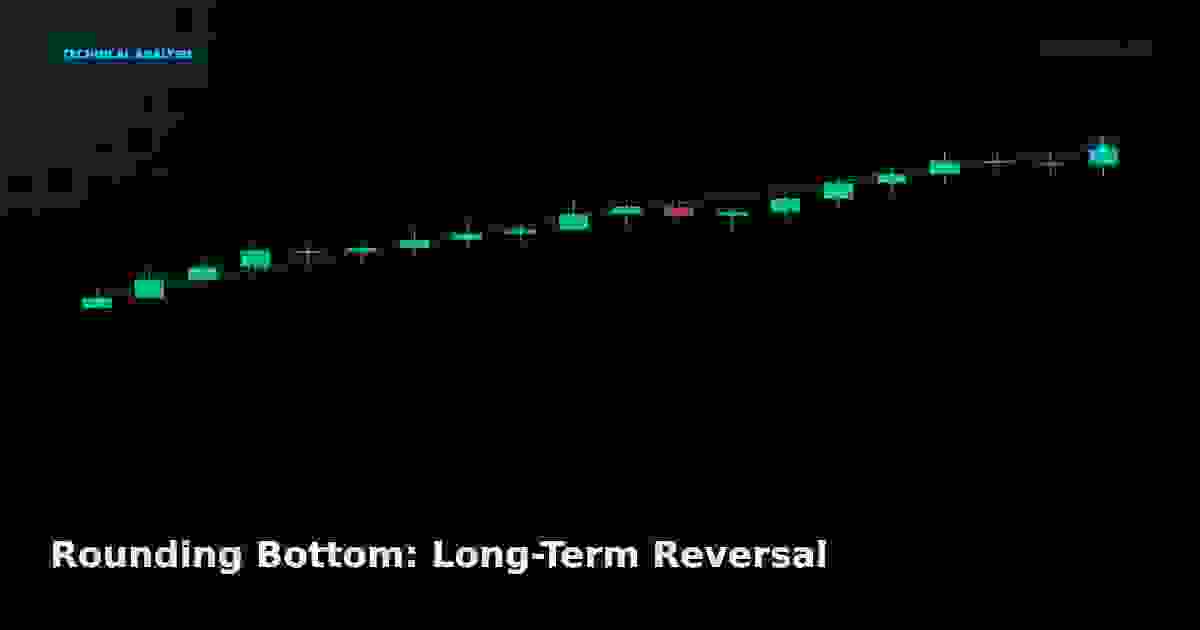
Rounding Bottom: Long-Term Reversal
The rounding bottom is a long-term bullish reversal pattern that resembles a saucer and signals a gradual shift from sellers to buyers.
What Is a Rounding Bottom?
The rounding bottom (also called a saucer bottom) is a long-term bullish reversal chart pattern that forms over weeks or months. It resembles a shallow bowl or saucer and signals a gradual transition from selling pressure to buying pressure. Unlike sharp V-bottoms, the rounding bottom shows a slow, sustained shift in sentiment.
What the Pattern Looks Like
The rounding bottom has these characteristics:
- Prior downtrend leading into the pattern
- A gradual, rounded decline that flattens at the bottom
- A gradual, rounded rally that mirrors the decline
- Volume that typically declines during the formation and increases on the right side
The pattern should look symmetrical, with the left and right sides of the bowl roughly equal in duration. The low point should be rounded, not sharp.
What It Signals
The rounding bottom signals a slow shift in control from sellers to buyers. As the pattern develops, selling pressure gradually fades, buyers step in, and volume builds on the right side. By the time price approaches the prior high (the "lip" of the saucer), buyers have firmly taken control.
Rounding bottoms are long-term patterns. Patience is essential — they can take months to complete.
How to Trade It
- Identify the rounded bottom after a sustained downtrend.
- Wait for confirmation. The pattern is confirmed when price breaks above the resistance level at the start of the pattern (the left lip).
- Enter on the breakout. Go long when price closes above the lip with strong volume.
- Place your stop-loss below the most recent swing low.
- Measure the target. Project the depth of the rounding bottom upward from the breakout point.
Trading Example
A stock falls from $60 to $40 over six months, then forms a rounded bottom that takes three months to complete. The low point is $40, and the lip sits at $50. When price breaks above $50 on strong volume, traders enter long with a stop below $45. The target is $50 - $40 = $10, projected up from $50 to give a target of $60.
Common Mistakes
- Entering too early before the pattern completes
- Treating sharp V-bottoms as rounding bottoms (they should be rounded)
- Ignoring volume — the right side should show increasing volume
Comparison: Rounding Bottom vs. Cup and Handle
| Feature | Rounding Bottom | Cup and Handle |
|---|---|---|
| Timeframe | Weeks to months | Weeks |
| Handle | None | Yes, a shallow pullback |
| Signal | Long-term reversal | Medium-term continuation |
The rounding bottom is favored by position traders and investors because it often marks major market lows and produces sustained advances when confirmed by volume and a clean breakout above resistance.
Live Chart
Open full chart →Related market data, powered by TradingView.
My Notes
Log in to save notes on this article and share them with the community.
Related
Read next
Triangle Breakouts: Probability by Type
Compare ascending, descending, and symmetrical triangle breakout probabilities with volume filters and target-measurement rules.
Read more →Smart Recommendations