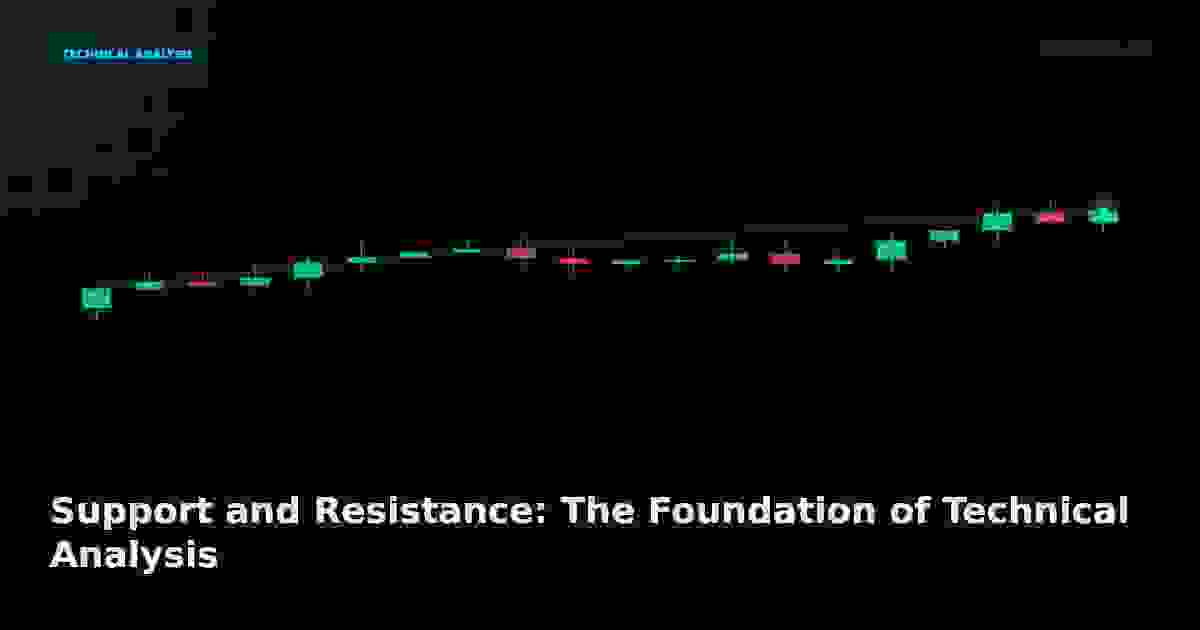
Support and Resistance: The Foundation of Technical Analysis
Support and resistance levels are price zones where buying or selling pressure repeatedly emerges, forming the basis of most chart analysis.
Support and Resistance — Support and resistance levels are price zones where buying or selling pressure repeatedly emerges, forming the basis of most chart analysis.
What Are Support and Resistance?
Support and resistance are the most fundamental concepts in technical analysis. They identify price levels where buying or selling pressure has repeatedly emerged, creating zones that tend to influence future price action. Almost every chart pattern and trading strategy relies on these levels in some form.
What the Levels Look Like
Support
- A price level where buying pressure emerges repeatedly
- Price tends to bounce higher when it approaches support
- Acts as a "floor" beneath the market
- Often forms at previous swing lows, round numbers, or moving averages
Resistance
- A price level where selling pressure emerges repeatedly
- Price tends to pull back when it approaches resistance
- Acts as a "ceiling" above the market
- Often forms at previous swing highs, round numbers, or moving averages
What They Signal
Support and resistance signal where buyers and sellers have historically agreed to transact. The more times price tests a level without breaking through, the more significant that level becomes. When price finally breaks through, the level often flips — old resistance becomes new support, and old support becomes new resistance.
The role reversal principle: broken resistance often becomes support, and broken support often becomes resistance.
How to Trade Them
- Identify key levels by marking previous swing highs and lows on multiple timeframes.
- Watch for reactions. Look for bounces, rejections, or candlestick patterns at these levels.
- Trade the bounce. Buy near support with a stop below, or short near resistance with a stop above.
- Trade the breakout. Enter when price closes beyond a level with strong volume, expecting a sustained move.
Trading Example
A stock has bounced off $50 three times over the past year, making $50 a strong support level. When price pulls back to $50 again and forms a bullish hammer candlestick, traders may enter long with a stop below $49. They target $55, the next resistance level above.
Common Mistakes
- Drawing support and resistance as single lines instead of zones
- Treating minor levels as major ones
- Ignoring higher-timeframe levels that override smaller ones
How Strong Are the Levels?
| Strength Factor | Description |
|---|---|
| Number of tests | More tests = stronger level |
| Timeframe | Higher timeframe = stronger level |
| Volume | High volume at the level = stronger |
| Recency | Recent tests = stronger |
Support and resistance are the foundation of technical analysis because they provide objective reference points for entries, exits, stop-losses, and profit targets across any market or timeframe.
References
Live Chart
Open full chart →Related market data, powered by TradingView.
My Notes
Log in to save notes on this article and share them with the community.
Related
Technical Analysis Essentials
Read price action without drowning in indicators. Candlesticks, trends, support/resistance, moving averages, and patterns.
strategyNews Trading Strategy: Trading Economic Events
A news trading strategy that captures the volatility spike after major economic releases, using tight rules and instant execution.
strategySupport and Resistance Bounce Strategy
A support and resistance bounce strategy that trades reversals at horizontal price levels where supply and demand have repeatedly clashed.
Read next
Yield Curve: Shapes and Recession Warning Signals
Read yield curve shapes — normal, flat, inverted, and steep — and use the 2s10s and 3m10y spreads as recession warning signals with documented lead times.
Read more →Smart Recommendations