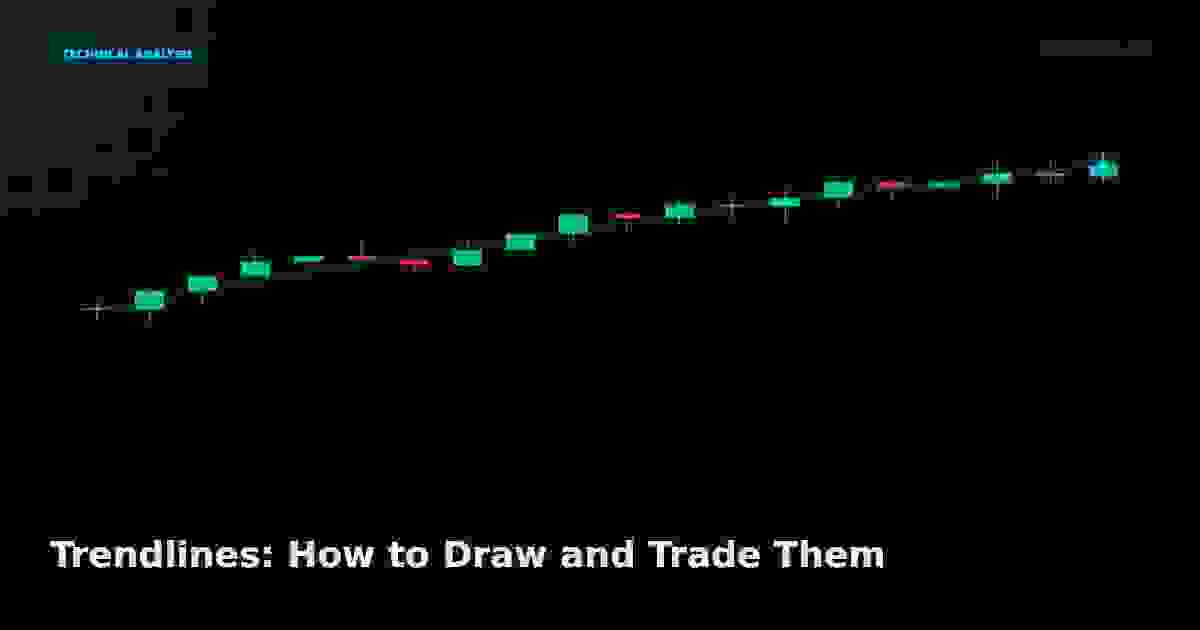
Trendlines: How to Draw and Trade Them
Trendlines are diagonal lines connecting swing highs or lows that show the direction and momentum of a trend.
Trendlines — Trendlines are diagonal lines connecting swing highs or lows that show the direction and momentum of a trend.
What Are Trendlines?
Trendlines are diagonal lines drawn on a chart to connect a series of swing highs or swing lows. They show the direction and slope of a trend, helping traders visualize momentum and identify potential reversal points. Trendlines are among the simplest and most widely used tools in technical analysis.
What Trendlines Look Like
There are three main types of trendlines:
Uptrend Line (Bullish)
- Connects a series of higher swing lows
- Slopes upward from left to right
- Acts as dynamic support — price tends to bounce off it
Downtrend Line (Bearish)
- Connects a series of lower swing highs
- Slopes downward from left to right
- Acts as dynamic resistance — price tends to pull back from it
Horizontal Trendline
- Connects swing highs or lows at roughly the same price
- Shows a range-bound market
- Acts as static support or resistance
What They Signal
Trendlines signal the direction and strength of a trend. A steep trendline suggests strong momentum, while a flat or shallow trendline suggests weak momentum. When price breaks a trendline, it often signals a reversal or a shift in trend strength.
The more times a trendline is tested, the more significant it becomes — but also the more likely it is to eventually break.
How to Draw Trendlines
- Identify the trend. Determine if price is making higher highs and higher lows (uptrend) or lower highs and lower lows (downtrend).
- Connect the points. For an uptrend, draw a line connecting two or more swing lows. For a downtrend, connect two or more swing highs.
- Extend the line. Project the line forward to anticipate where price may react next.
- Validate the line. A trendline needs at least three touch points to be considered valid.
How to Trade Them
- Trade the bounce. Buy near an uptrend line with a stop below it, or short near a downtrend line with a stop above it.
- Trade the breakout. Enter when price closes beyond the trendline with strong volume.
- Adjust the slope. As momentum changes, redraw trendlines to reflect steeper or shallower angles.
Trading Example
A stock rises from $40 to $50, pulls back to $45, then rises to $55. Drawing a line from the $40 low through the $45 low creates an uptrend line. When price pulls back to touch the line near $48, traders may enter long with a stop below the trendline, targeting new highs.
Common Mistakes
- Forcing trendlines to fit price action instead of letting price dictate them
- Using too few touch points (two is a draft, three is confirmation)
- Ignoring the angle — overly steep trendlines break easily
Trendlines are popular among traders of all styles because they're easy to draw, work across any timeframe, and provide clear visual references for entries, stop-losses, and breakout trades.
References
Live Chart
Open full chart →Related market data, powered by TradingView.
My Notes
Log in to save notes on this article and share them with the community.
Related
Technical Analysis Essentials
Read price action without drowning in indicators. Candlesticks, trends, support/resistance, moving averages, and patterns.
strategyNews Trading Strategy: Trading Economic Events
A news trading strategy that captures the volatility spike after major economic releases, using tight rules and instant execution.
Read next
Yield Curve: Shapes and Recession Warning Signals
Read yield curve shapes — normal, flat, inverted, and steep — and use the 2s10s and 3m10y spreads as recession warning signals with documented lead times.
Read more →Smart Recommendations