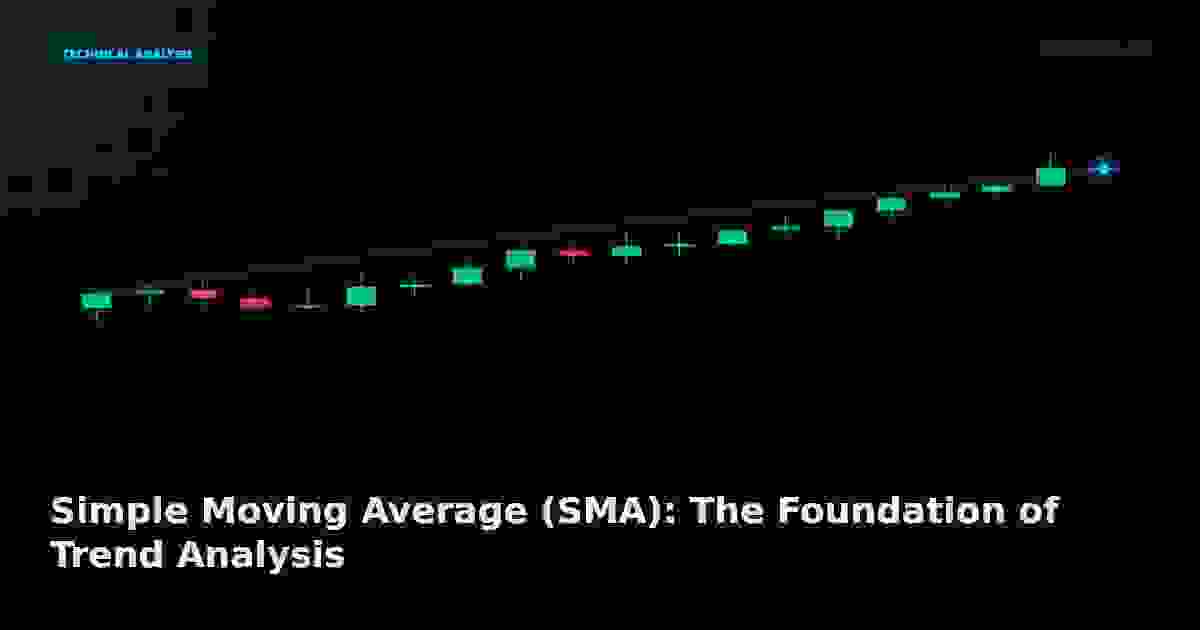
Simple Moving Average (SMA): The Foundation of Trend Analysis
The Simple Moving Average is the most basic trend indicator. Learn how SMA is calculated, which periods matter, and how to read it on any chart.
Simple Moving Average (SMA): The Foundation of Trend Analysis
If you only learn one indicator, make it the Simple Moving Average. Everything else builds on it.
The Simple Moving Average (SMA) is the arithmetic mean of prices over a chosen number of periods. It is the oldest and most widely used trend-following indicator in technical analysis — and the easiest to understand.
How the SMA is calculated
The SMA adds up the closing prices for the last N periods and divides by N:
SMA(N) = (P1 + P2 + P3 + ... + PN) / N
Worked example — last 5 daily closes: $20, $21, $19, $22, $23.
SMA(5) = (20 + 21 + 19 + 22 + 23) / 5 = 105 / 5 = $21
When a new day closes at $24, the oldest value ($20) drops off and $24 enters, so the SMA "moves" forward.
Why traders use it
| Purpose | How the SMA helps |
|---|---|
| Trend direction | Price above a rising SMA = uptrend |
| Dynamic support | Pullbacks often stall at the 20 or 50 SMA |
| Trend filter | 200 SMA separates bull from bear markets |
| Signal generation | Crossovers between fast and slow SMAs |
The periods that matter
- 9 SMA — short-term momentum, day trading
- 20 SMA — the default; swing traders' go-to support level
- 50 SMA — medium-term trend; institutional benchmark
- 100 SMA — major S/R level on daily charts
- 200 SMA — the granddaddy; long-term bull/bear line
A market above its 200-day SMA is considered a long-term uptrend. Below it, a long-term downtrend. This single rule keeps you on the right side of the market.
Reading the slope
The angle of the SMA matters as much as the crossover:
- Steep upward slope — strong, healthy uptrend
- Steep downward slope — strong downtrend
- Flat / horizontal — ranging market; crossovers here are unreliable
Pros and cons
| Advantage | Disadvantage |
|---|---|
| Simple and stable | Lags behind sharp reversals |
| Few whipsaws on high timeframes | Slow to react to recent price |
| Works on every market and timeframe | Equal weighting ignores recency |
Common mistakes
- Stacking too many SMAs — three is plenty; five is clutter
- Trading every crossover — most whipsaw in ranging markets
- Expecting the SMA to predict — it confirms, it does not forecast
How to start
- Place the 200 SMA on a daily chart to define the long-term trend
- Add the 20 SMA for short-term direction and dynamic support
- Trade only in the direction of the 200 SMA
- Size each position with our position size calculator before entry
Summary
The SMA is the foundation every other moving average is built on. It is smooth, stable, and easy to read. Master one or two periods on a daily chart before adding anything more complex.
Live Chart
Open full chart →Related market data, powered by TradingView.
My Notes
Log in to save notes on this article and share them with the community.
Related
Read next
VWAP for Intraday Trading: Anchors, Bands, and Reversions
Apply VWAP with anchors, standard-deviation bands, and reversion logic to time intraday entries, exits, and institutional flow confirmation.
Read more →Smart Recommendations