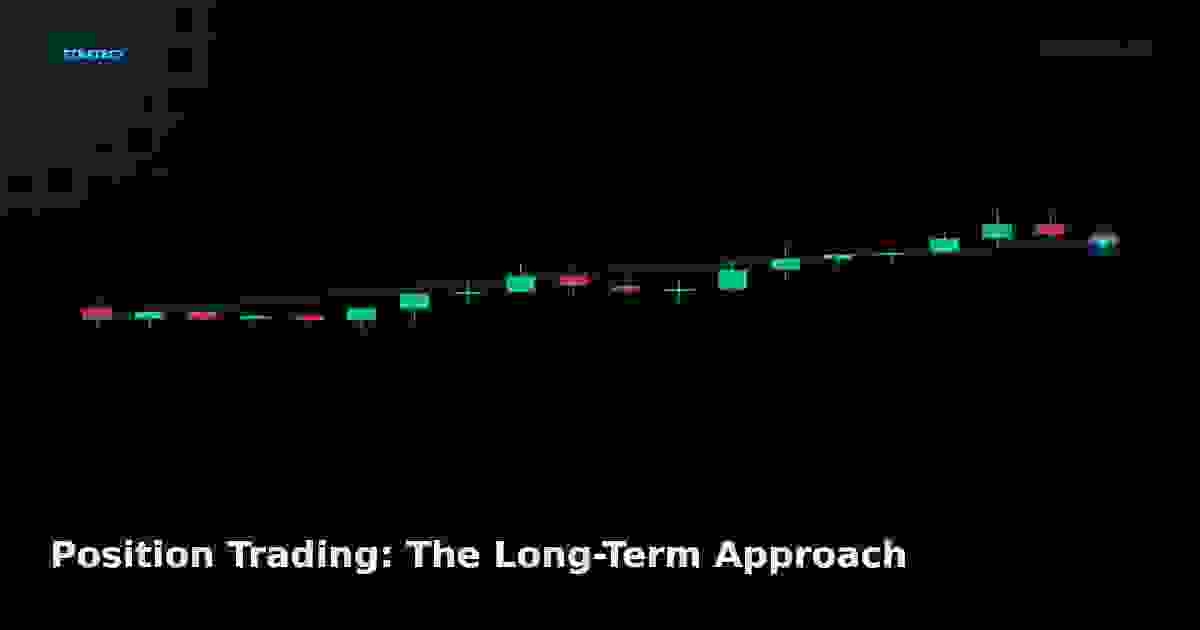
Position Trading: The Long-Term Approach
A position trading strategy that holds trades for weeks to months, capturing large macro moves with minimal screen time and low stress.
Overview
Position trading is the long game. Trades last weeks to months, built on a macro or structural thesis rather than intraday noise. The position trader accepts slower feedback and larger drawdowns per trade in exchange for the largest potential moves and the lowest time commitment. It is ideal for those who think in themes, not ticks.
Setup
- Instruments: index ETFs, commodity ETFs, forex majors, large-cap stocks
- Timeframe: weekly and daily charts
- Indicators: 50 SMA and 200 SMA on the daily, ATR(14), the higher-timeframe trend
- Market regime: a structural macro tailwind (rate cycle, commodity cycle, earnings cycle)
A valid setup combines a fundamental thesis (e.g., falling rates, rising demand) with a technical trend on the weekly chart.
Entry rules
- Weekly trend must be up: price above the 200 SMA, 50 SMA rising
- Wait for a daily pullback to the 50 SMA or a major support zone
- Enter on a daily bullish reversal candle that confirms buyers have stepped in
- Build the position in two halves — half on the reversal, half on the next pullback
Stop loss
- Stop below the most recent weekly swing low
- Alternative: 2 × ATR(14) on the daily below entry, to absorb normal volatility
- Never use a tight stop; position trades need room to breathe through pullbacks
Use the stop loss calculator to size the stop in price terms.
Take profit
- Hold the core position until the weekly trend breaks (price closes below the 50 SMA on weekly)
- Take partial profits at major resistance or after a 3R move
- Trail with the 50 SMA on the weekly chart
Confirm the target with the risk-reward calculator.
Risk management
- Risk 1% to 2% of account equity per position (lower end for larger, longer holds)
- Position size = risk amount ÷ (entry − stop). Verify with the position size calculator
- Maximum three open position trades in correlated themes
- Review open trades weekly; cut any position whose macro thesis has changed
When it fails
Position trading fails when the macro thesis is wrong but the trader refuses to admit it. A weekly close below the 50 SMA is the technical signal that the thesis is broken. The strategy rewards patience but punishes stubbornness — know the difference.
Backtest Results
Hypothetical backtest — past performance does not guarantee future results. These numbers are illustrative, not a promise. Always forward-test on demo before live trading.
Test parameters:
- Instrument: SPY, GLD, and broad commodity ETFs (macro themes)
- Timeframe: Weekly (structure) and Daily (entry)
- Period: 2020-01-01 to 2025-12-31 (5 years)
- Risk per trade: 1% of account
- Commission/slippage: included
| Metric | Value |
|---|---|
| Total trades | 108 |
| Win rate | 42% |
| Average win | +3.8R |
| Average loss | -1.3R |
| Expectancy | +0.84R |
| Max drawdown | 25% |
| Annualized return | 18% |
| Profit factor | 2.1 |
| Best trade | +10.5R |
| Worst trade | -1.6R |
| Avg trades/month | 1.8 |
What the numbers mean
Few trades, large average win, large drawdown — the classic position-trading profile. The 25% drawdown is the price of holding through multi-week pullbacks, and the positive expectancy comes entirely from the handful of trades that run for months. The wide average loss reflects trailing stops that give back open profit on reversals.
Weaknesses to watch
- Months can pass with no valid setup, tempting you to force low-quality entries that drag the expectancy down
- A wrong macro thesis held too long produces outsized losses because the wide stop and trailing logic keep you in a dying trend
- Correlated macro themes (risk-on equities plus risk-on commodities) cluster drawdowns into a single regime break, so cap exposure per theme, not per ticker
How to use this data
Use these numbers as a baseline expectation. If your live results are significantly worse after 50+ trades, something is off — either the market regime changed, or your execution differs from the backtest. Do NOT scale position size based on backtest optimism.
My Notes
Log in to save notes on this article and share them with the community.
Strategy is for educational purposes only. Not financial advice.
Related
Building a Trading Strategy
Turn scattered setups into a real strategy. Entries, exits, stops, backtesting, and iteration.
blogAUD, CAD, NZD: Commodity Currency Linkage Mechanics
AUD, CAD, and NZD track iron ore, WTI, and dairy exports; quantifying each pair's commodity beta lets traders filter fakeouts and confirm fundamental flow.
blogBitcoin and Tech Stocks: How the Correlation Evolved
Bitcoin's Nasdaq correlation rose from near zero to 0.8 by 2022; traders track regime shifts between digital gold and risk-asset modes.
Read next
Dual Moving Average Crossover Strategy (Beginner Edition)
One of the most classic trend-following strategies. Simple rules, easy to execute, ideal for beginners trading stocks or crypto on daily timeframes.
Read more →