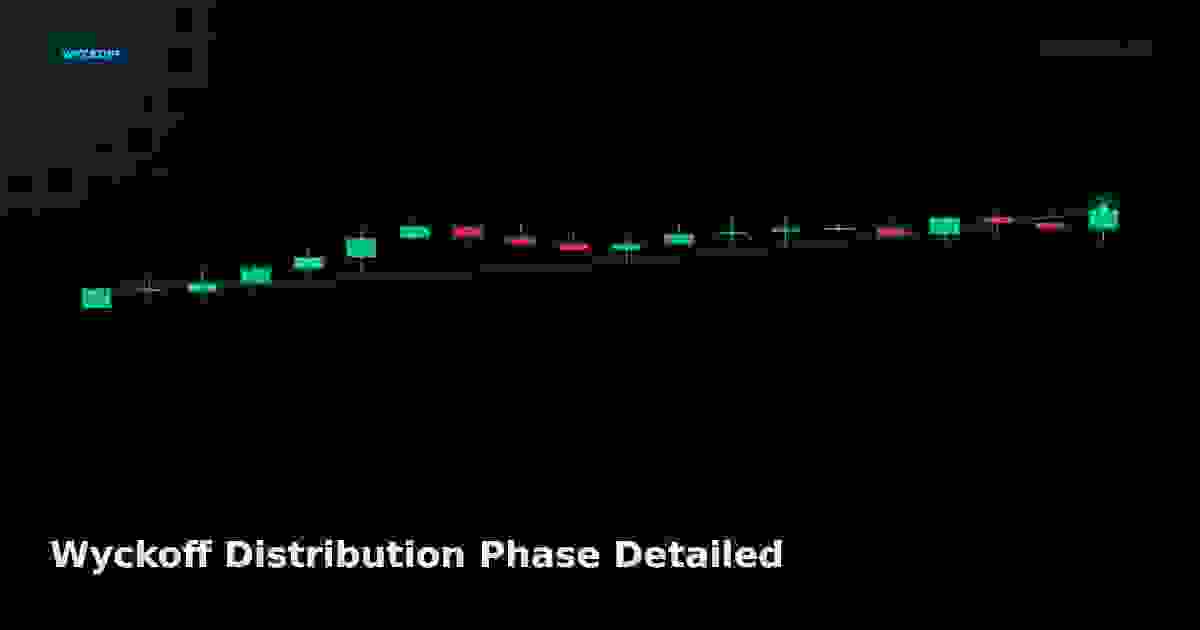
Wyckoff Distribution Phase Detailed
Distribution mirrors accumulation at market tops — learn the five phases, the upthrust, and the sign of weakness that signals the start of markdown.
Wyckoff Distribution Phase Detailed
Distribution is the mirror image of accumulation. It occurs at market tops, where large operators quietly sell their holdings to an eager, greedy public. The distribution schematic maps this process with the same precision as accumulation — and recognizing it can save you from holding through devastating markdowns.
The context: after a markup
Distribution begins after a prolonged uptrend. The public is euphoric, chasing breakouts, certain that prices will rise forever. Smart money sees exhaustion and begins distributing shares — selling into the rallies, supporting briefly to encourage more buying, but ultimately exiting. This transition from markup to distribution is marked by a Preliminary Supply (PSY) and a Buying Climax (BC).
Phase A: stopping the uptrend
- Preliminary Supply (PSY): the first sign that buying pressure is meeting resistance. Volume increases, upside narrows. Large operators are beginning to sell.
- Buying Climax (BC): the euphoria bar. Wide spread up, ultra-high volume, close off the high. Buyers are exhausted; sellers are aggressively distributing.
- Automatic Reaction (AR): price falls sharply as residual supply overwhelms demand. The low of this reaction defines the bottom of the distribution range.
- Secondary Test (ST): price revisits the BC high on diminished volume, confirming that buying power is exhausted.
Phase A's job is to stop the uptrend and establish the trading range.
Phase B: distributing the cause
Phase B is long. Price oscillates within the range defined by the BC high and AR low. Large operators distribute patiently, selling into rallies and supporting briefly on dips to encourage further buying. Volume is variable, often higher on up days (where distribution occurs) than on down days. Multiple Secondary Tests may occur.
Phase B is exciting by design — the public sees a consolidation and expects a continuation. They buy every dip. This is exactly what the composite operator needs to exit.
Phase C: the upthrust (UTAD)
Phase C mirrors the spring. Here, the composite operator engineers a final rally to trap late buyers:
- Upthrust (UT): price briefly breaks above the resistance of the trading range (the BC high), often on moderate volume, then snaps back. This triggers buy stops above resistance and induces final FOMO buying — exactly the buyers to whom the CO sells.
- Upthrust After Distribution (UTAD): a more dramatic upthrust that occurs late in the distribution, confirming that demand is exhausted. The UTAD is the bearish mirror of the spring.
- Test of the UTAD: a subsequent minor rally that fails to reach the UTAD high, on reduced volume. This confirms demand is exhausted.
An UTAD that occurs on high volume but fails to follow through on the upside is a textbook effort/result divergence — demand is exhausted.
Phase D: supply enters
Once the UTAD confirms that demand is gone, supply begins to dominate:
- Sign of Weakness (SOW): a wide down bar on high volume that breaks below prior support within the range
- Backup to the Edge of the Creek (BUEC): a rally that holds below the prior support (now resistance) on reduced volume — the classic Wyckoff short entry
- LPSY (Last Point of Supply): another name for the BUEC, the final low-risk short entry before markdown
Phase D shows lower highs and lower lows within the range — supply is now in control.
Phase E: markdown begins
Price breaks below the AR low (the bottom of the range) on strong volume. The distribution is complete. The markdown phase — the downtrend — begins in earnest.
How to trade distribution
- Identify the range after a markup (Phase A complete)
- Wait for the UTAD (Phase C) — the highest-probability short entry
- Confirm with the SOW — never short the UTAD without seeing follow-through to the downside
- Enter on the BUEC — the rally after the SOW, with a stop above the UTAD high
- Target: use point-and-figure counting to project the size of the markdown from the distribution range
Common mistakes
- Buying Phase B breakouts: mistaking distribution rallies for continuation and buying at the top
- Shorting too early: shorting Phase B highs before the UTAD confirms exhaustion, getting squeezed
- Missing the SOW: shorting the UTAD without confirmation, getting stopped on the test rally
- Ignoring volume: an UTAD on rising volume is suspect — true UTADs show diminished or absorbing volume
Asymmetric opportunity
Distribution trades are often higher-reward than accumulation trades. Markdowns tend to be faster and steeper than markups — fear drives prices down faster than greed drives them up. A correctly identified distribution offers some of the best risk/reward setups in trading.
Summary
The distribution schematic mirrors accumulation: Phase A stops the advance, Phase B builds the cause, Phase C upthrusts the trap on late buyers, Phase D confirms supply, Phase E launches the markdown. Identify each event in sequence, wait for confirmation, and enter short at the BUEC with a structural stop above the UTAD.
Live Chart
Open full chart →Related market data, powered by TradingView.
My Notes
Log in to save notes on this article and share them with the community.
Read next
Wyckoff vs SMC vs Supply and Demand: A Method Comparison for Traders
A head-to-head comparison of Wyckoff, Smart Money Concepts, and supply/demand methods, covering strengths, weaknesses, and when each approach fits best.
Read more →Smart Recommendations