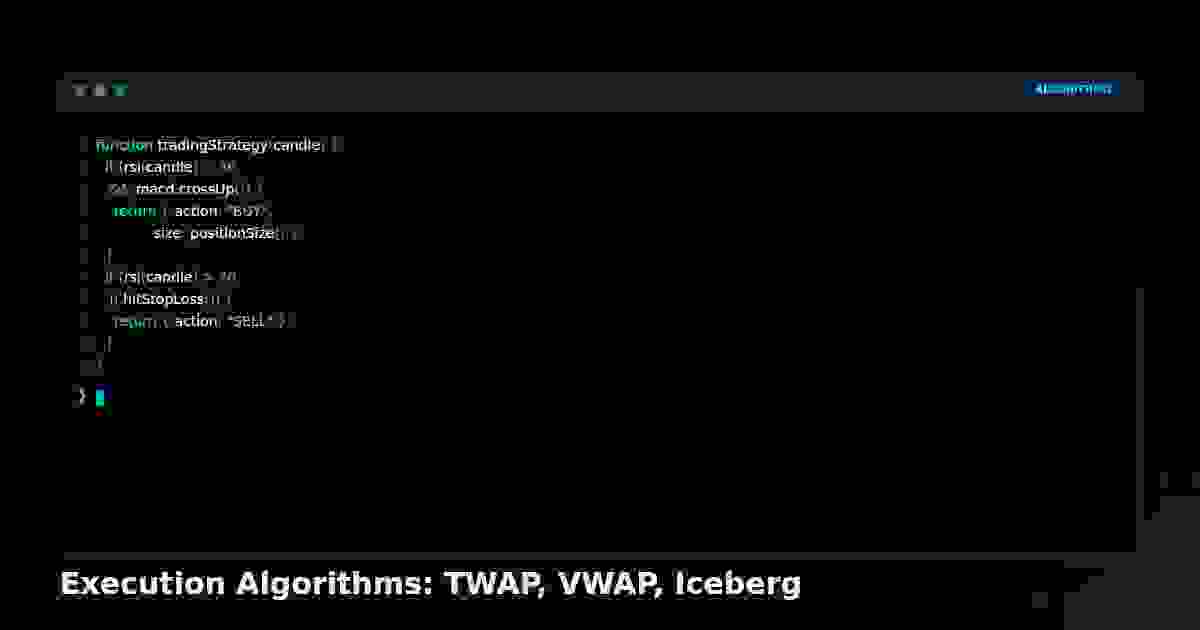
Execution Algorithms: TWAP, VWAP, Iceberg
Getting into a position without moving the market against you is a skill in itself. Learn TWAP, VWAP, and iceberg execution algorithms and when to use each.
Execution Algorithms: TWAP, VWAP, Iceberg
A great signal with bad execution is a mediocre strategy. The fill price is part of your edge.
Once a strategy says "buy 10,000 shares," the question becomes how. Dumping a single market order that size will move the price against you — a cost called market impact. Execution algorithms slice large orders into pieces to minimize this impact.
The cost of naive execution
If you market-order 10,000 shares of a thinly traded name, you'll eat through multiple price levels. Your average fill is far worse than the screen price. That gap — between the price you saw and the price you got — is slippage. For retail it's small; for size, it can erase an entire edge.
TWAP: time-weighted average price
Time-Weighted Average Price splits an order evenly across a time window:
Slice size = Total ÷ N_slices
Example: buy 10,000 shares over 100 minutes → 100 shares per minute.
- Strength: simple, no data dependency, minimizes timing risk
- Weakness: ignores volume patterns; trades heavily in dead periods when impact is highest
- Best for: low-volume periods you want to disguise, or when no volume profile is available
VWAP: volume-weighted average price
VWAP slices the order proportional to historical volume:
VWAP = Σ(Price_i × Volume_i) ÷ Σ(Volume_i)
Each slice's size matches the share of typical volume at that time of day. You trade more when liquidity is deep (open and close) and less during the lunch lull.
- Strength: aligns trades with liquidity, minimizes market impact
- Weakness: needs a reliable volume profile; sudden volume bursts can mislead it
- Best for: large orders during normal trading hours on liquid instruments
Iceberg: hiding your size
An iceberg order shows only a small portion of the total to the order book, refilling as each visible piece fills. The rest is hidden.
Visible = min(slice, max_show)
Hidden = Total − Visible
- Strength: prevents front-running by traders watching the book
- Weakness: slower fills; if the book moves, you may miss the window
- Best for: large orders on transparent books where signaling is dangerous
Choosing between them
| Need | Algorithm |
|---|---|
| Simple, time-driven | TWAP |
| Minimize impact, normal liquidity | VWAP |
| Hide large size from book watchers | Iceberg |
| Urgent entry | Single market order (accept the slippage) |
| Patient, no signal to the market | Iceberg + VWAP hybrid |
Implementation cautions
- Cost modeling: always backtest with realistic slippage, not the mid-quote
- Dark pools: route slices through dark venues to avoid signaling
- Smart order routing: split across exchanges to capture best available liquidity
- Adaptive logic: scale slice size with realized volatility; pause if the spread widens
Summary
A signal that says "buy" is half the trade. The other half is how you buy without telling the market. TWAP for simplicity, VWAP for impact minimization, iceberg for stealth. Match the algorithm to the order's urgency, size, and the liquidity profile of the instrument — because slippage is a real, recurring cost that quietly erodes every strategy.
Live Chart
Open full chart →Related market data, powered by TradingView.
My Notes
Log in to save notes on this article and share them with the community.
Read next
Quant Research Workflow: Jupyter Notebooks and Feature Engineering
A repeatable quant research workflow using Jupyter notebooks covers feature engineering, validation, and notebook hygiene that produces deployable signals.
Read more →Smart Recommendations