Harami and Doji Combination Patterns
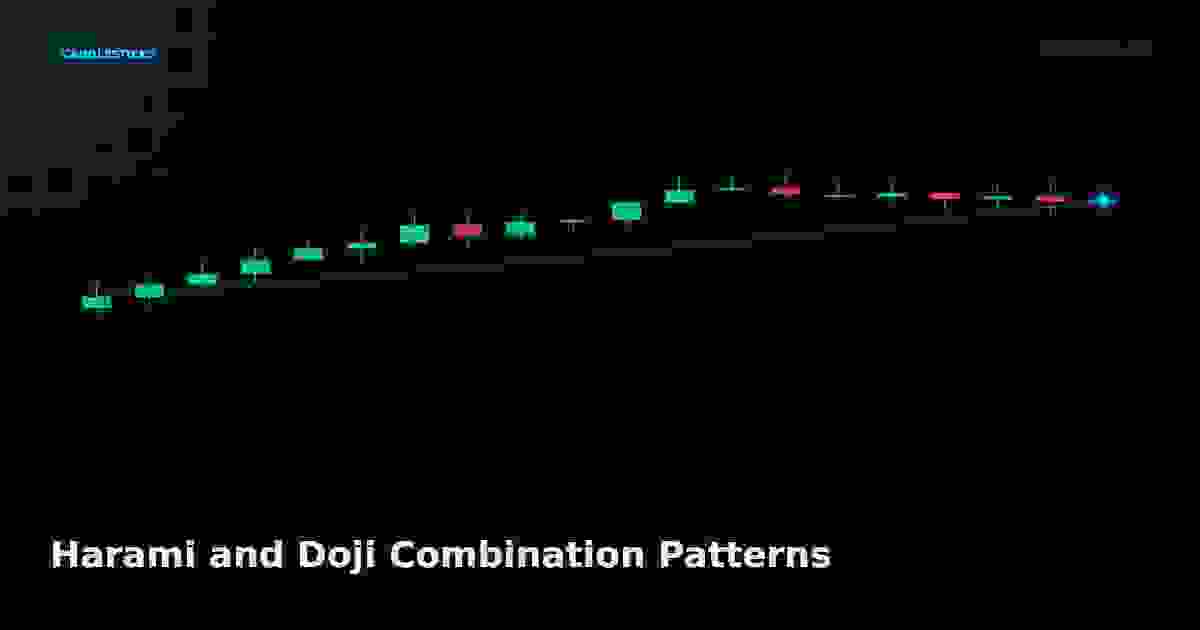
When a harami's inside candle is itself a doji, the combined formation signals acute indecision that often precedes meaningful reversals at structural levels.
Harami and Doji Combination Patterns
The harami and the doji are individually useful candlestick signals. Combined — a harami whose inside candle is a doji — they form a more potent formation that captures a specific market condition: a sudden collapse of momentum after a directional move. Understanding when and why this combination works separates high-probability setups from noise.
The Component Patterns
Harami — a long mother candle followed by a small-bodied inside candle whose range is entirely contained within the mother candle's body. The pattern signals that the prior trend's momentum has stalled.
Doji — a candle where open and close are virtually identical, producing a cross or plus shape. It represents pure indecision between buyers and sellers.
The Combination: Harami Cross
When the inside candle of a harami is a doji, the formation is called a harami cross. The structure is:
- A long trend candle (bullish or bearish).
- A doji whose entire range sits within the prior body.
The interpretation: the dominant side pushed price decisively, then immediately lost control. The doji is the market refusing to commit in the prior direction. Statistically, this combination produces reversals more often than a plain harami because the doji adds a second layer of indecision evidence.
Where the Combination Works
The harami cross is most reliable:
- After an extended trend — at least five to seven candles in one direction. A cross after two candles is meaningless.
- At major structure — daily pivots, prior swing highs/lows, moving averages, or Fibonacci retracement zones. The cross alone is weak; the cross at structure is the trade.
- On higher timeframes — daily and H4 patterns carry weight; M5 and M15 versions are routinely noise.
- With volume confirmation — the mother candle ideally forms on elevated volume, while the doji forms on reduced volume, confirming that participation faded rather than reversed outright.
Entry and Management
A conservative execution:
- Entry: On a break of the doji's high (bullish harami cross, signaling reversal up) or low (bearish harami cross). Entering on the doji close itself is premature.
- Stop: Just beyond the mother candle's extreme — if the mother candle's high or low is breached, the reversal thesis is invalid.
- Target: The nearest structural level in the reversal direction, or a measured move equal to the mother candle's range.
Common Failure Modes
The harami cross fails predictably when:
- The mother candle is not actually long — a small mother candle produces a meaningless inside doji.
- The doji forms in the middle of a range, with no trend to reverse.
- Price gaps beyond the mother candle's extreme on the next session, invalidating the structure.
- Traders enter on the doji itself rather than waiting for confirmation.
The Pitfall of Over-Reading
Not every doji inside a candle is a harami cross worth trading. The pattern's value comes from the contrast between a committed mother candle and an indecisive doji. When the mother candle is itself modest, or when the doji is merely one of several small candles in a chop, the signal carries little weight. The advanced trader reserves the harami cross for clean, extended-trend contexts at structural levels.
Used with discipline, the harami cross offers a defined-risk entry into reversals at the exact moment momentum collapses — a combination few single-candle patterns can match.
Live Chart
Open full chart →Related market data, powered by TradingView.
My Notes
Log in to save notes on this article and share them with the community.
Read next
VaR and CVaR Calculation Methods and Their Limitations
VaR and CVaR calculation methods — historical, parametric, and Monte Carlo — with Python implementation and the specific limitations each method hides.
Read more →Smart Recommendations