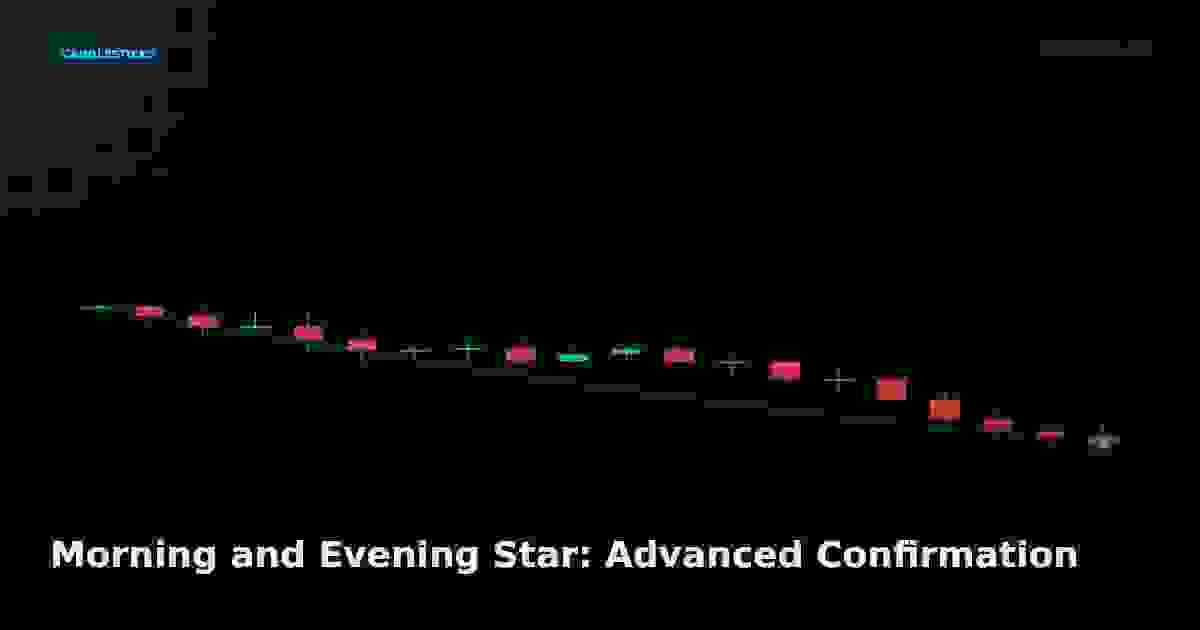
Morning and Evening Star: Advanced Confirmation
The morning and evening star patterns gain real predictive power only when the third candle is confirmed by volume, gap behavior, and structural location.
Morning and Evening Star: Advanced Confirmation
The morning star and evening star are textbook reversal patterns: a three-candle formation in which a small-bodied middle candle separates a long trend candle from a long reversal candle. The narrative is appealing — indecision interrupts the trend, then control flips. In practice, however, the textbook version triggers too many false signals. The advanced trader waits for confirmation that the third candle actually represents a committed reversal.
The Textbook Structure
Morning star (bullish reversal after a decline):
- Long bearish candle.
- Small-bodied candle — spinning top, doji, or harami-style — that gaps or ranges below the prior close.
- Long bullish candle closing well into the first candle's body, ideally beyond its midpoint.
Evening star mirrors the structure after a rally.
Why the Textbook Version Fails
The pattern's weakness is the middle candle. A small-bodied candle can reflect genuine indecision, but it can equally reflect low-volume drift, a news lull, or a brief pause before continuation. Without confirmation, the third candle's strength may be a one-bar spike that immediately reverses. Naive traders enter on the third candle close and get stopped out on the fourth.
The Advanced Confirmation Stack
To elevate the morning/evening star from a 50/50 setup to a high-probability trade, require:
Location at structure — the pattern must form at a major support (morning) or resistance (evening), such as a daily pivot, a prior swing, or a moving average. Mid-air patterns are discarded.
Volume profile — the third candle should close on volume exceeding the 20-period average, ideally expanding relative to the middle candle. Falling volume on the reversal candle invalidates the signal.
Body penetration — the third candle must close beyond the midpoint of the first candle. A close barely into the first body is weak; a close near the first candle's open is strong.
Fourth-candle confirmation — the truly conservative approach waits for the next candle to confirm by holding above the third candle's midpoint (for a morning star) without retracing into the first candle's body. This sacrifices some entry price for substantially higher reliability.
Entry and Risk
A typical execution:
- Entry: On the close of the confirming fourth candle, or on a break of the third candle's high (morning star) with a stop order.
- Stop: Below the pattern's low — the lowest wick across the three candles. This is well-defined and structural.
- Target: The prior swing high (morning star) or a measured move equal to the pattern's range projected upward.
The Gap Consideration
In markets with genuine overnight gaps (equities), a morning star with a real gap between the first and middle candle, and between the middle and third candle, is far stronger than a contiguous version. Gaps reflect overnight order imbalance. In 24-hour markets like FX, where gaps are rare, the pattern relies entirely on body behavior and volume.
The Honest Read
Morning and evening stars are not high-probability patterns in their raw form. They become high-probability setups only when filtered by location, confirmed by volume, and ideally verified by a fourth candle. The disciplined trader accepts fewer signals in exchange for reliability.
Live Chart
Open full chart →Related market data, powered by TradingView.
My Notes
Log in to save notes on this article and share them with the community.
Read next
VaR and CVaR Calculation Methods and Their Limitations
VaR and CVaR calculation methods — historical, parametric, and Monte Carlo — with Python implementation and the specific limitations each method hides.
Read more →Smart Recommendations